Analysis | Read time: 8 minutes
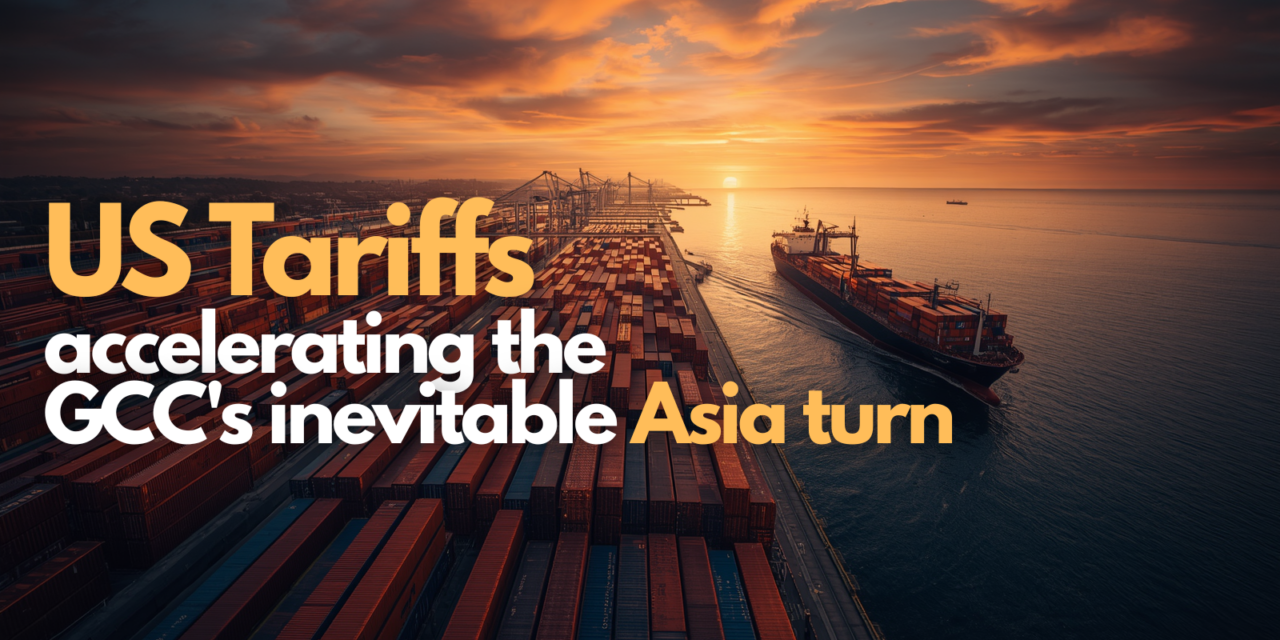
US tariffs are pushing GCC states toward Asian trade partners at a pace that policymakers in Washington appear to have underestimated.[1]
The six members of the Gulf Cooperation Council collectively export less than 4 percent of their goods to the United States, yet the indirect consequences of Washington’s tariff policies are severe [2]. A 10 percent universal baseline tariff and duties of up to 145 percent on Chinese imports have upended long-standing trade routes, and the effects are landing directly on Gulf manufacturing sectors.
Universal baseline tariffs have nullified zero-duty access for countries like Oman, which previously relied on a bilateral Free Trade Agreement with the US [3]. For the rest of the region, manufacturing sectors face a standard 25 percent Section 232 tariff on steel and aluminum components, alongside new levies on petrochemical derivatives [4]. These barriers accelerate a realignment that was already underway: a permanent pivot away from Western economic frameworks and toward Asia.
This transition no longer involves selling crude oil to eastern markets. It is a systematic reorganization of trade frameworks, export lanes, and sovereign wealth allocation across the UAE, Oman, Saudi Arabia, and Qatar.
US tariff pressure is ending the GCC’s transatlantic balancing act
For decades, GCC states maintained a position that balanced US security infrastructure against Asian hydrocarbon demand. The 2025 tariff shock made that position economically unworkable.
According to data from the Tax Foundation, the average effective tariff rate in the US reached 7.7 percent in late 2025, the highest level since 1947 [5]. These duties function as a direct tax on Gulf industrial diversification. Under economic blueprints like Saudi Arabia’s Vision 2030 and the UAE’s We the UAE 2031, these states invest heavily in non-oil industries, including aluminum smelting, specialized machinery, and green chemicals.[6]
The standard 25 percent Section 232 tariff applied to these products makes them non-competitive for US buyers [4]. Because Gulf currencies remain pegged to the US dollar, any tariff-driven appreciation of the dollar automatically strengthens regional currencies and makes Gulf-manufactured goods more expensive in global markets, which squeezes profit margins for non-oil exporters.
The International Energy Agency noted in late 2025 that US protectionism and the resulting domestic manufacturing slowdown in China caused global oil demand growth to flatten [7]. Confronted with shrinking Western market access and volatile energy pricing, Gulf policymakers are concentrating resources on markets where trade barriers are falling rather than rising.
Bilateral CEPA frameworks are building an independent Asian trade network
To secure alternative markets, GCC nations are deploying Comprehensive Economic Partnership Agreements (CEPAs) at an accelerating rate. These bilateral frameworks bypass slow multilateral negotiations to eliminate tariffs quickly, harmonize digital customs procedures, and remove barriers to service industries.
The UAE leads this approach, replacing the traditional hub-and-spoke trade structure with direct, overlapping agreements between individual Gulf states and major Asian economies. Following early deals with India and Indonesia, the UAE finalized agreements with South Korea and Cambodia.[8]
According to the Indian Ministry of Commerce, trade volume between the GCC and Asia grew by 8.2 percent in the first half of 2025, with Indian merchandise exports to the UAE rising by over 9 percent in the same period, driven by electronics and engineering goods moving through Gulf logistics hubs.[9]
Other Gulf nations are following this approach:
- Oman: To offset the loss of its US trade advantages, Muscat is negotiating bilateral deals across South and Southeast Asia, with a focus on maritime routes that bypass the Strait of Hormuz.[3]
- Saudi Arabia: The Kingdom is prioritizing the long-delayed China-GCC Free Trade Agreement, treating Beijing as the primary buyer for its expanding downstream petrochemical output.[10]
- Qatar: Doha is embedding long-term supply guarantees into economic partnerships with Japan, South Korea, and China, connecting energy infrastructure with digital economy investment.[11]
These agreements create a predictable regulatory environment. By standardizing digital certificates of origin, data privacy rules, and cross-border payment systems, the GCC and Asian economies are building a trade ecosystem that functions independently of Western protectionist policy.
Petrochemical and materials flows are redirecting away from Western markets
The physical movement of goods reflects the regulatory shift. US tariffs are pushing Chinese manufacturers to relocate production capacity into the Gulf, using the region’s low-cost energy and transport infrastructure to reach global markets.
The petrochemical realignment
Gulf state-owned energy firms are moving away from crude exports to produce high-value chemical polymers and advanced materials. Because Western markets apply protectionist duties to these products, the flows are turning toward Asian manufacturing hubs.
Saudi Aramco and China’s Sinopec are expanding joint-venture refineries within China, including facilities in Fujian and Shandong provinces [12]. These projects lock in long-term Saudi crude demand by processing it directly into industrial chemicals on Asian soil.
The metals corridor
Gulf aluminum smelters, including Emirates Global Aluminium and Oman’s Sohar Aluminium, are redirecting supply chains away from North America [4] and integrating directly into the Asian automotive and electronics supply chains, where demand for lightweight materials remains high.
Re-export logistics
The UAE’s Jebel Ali Free Zone and Oman’s Port of Salalah are changing their operating models. Rather than acting as transit stops for goods moving to Europe or North America, both ports now function as assembly and distribution centers for Asian corporations. Components arrive from manufacturing centers such as Shenzhen and Chennai, workers assemble them within Gulf free zones to establish local origin status, and the finished products move across East Africa, Central Asia, and the broader Middle East.
Sovereign wealth deployment is following trade flows into Asia
The shift in physical trade is matched by a reallocation of state-backed capital. The region’s sovereign wealth funds (SWFs), which collectively manage between $4 trillion and $6 trillion, are reducing exposure to Western public equities and fixed-income assets to invest directly in Asian growth industries.[13]
Data from the Middle East Council on Global Affairs shows that Gulf SWFs now account for more than 40 percent of global sovereign wealth assets [14]. In the past, these funds bought US Treasury bonds and Western real estate.
Today, Saudi Arabia’s Public Investment Fund (PIF), the Abu Dhabi Investment Authority (ADIA), and the Qatar Investment Authority (QIA) take ownership stakes in East Asian semiconductor manufacturing, Indian renewable energy projects, and ASEAN digital logistics networks.
The PIF’s current five-year strategy centers on co-investment structures that attract third-party capital into semiconductors, data centers, and renewable energy [6]. The objective is no longer purely financial return. It is securing technology transfers that support domestic industrialization.
Mubadala and ADIA have opened offices in Beijing and Mumbai, with local investment teams targeting mid-market technology firms, electric vehicle supply chains, and digital logistics platforms across ASEAN [15]. By anchoring capital in Asian economies, Gulf sovereign funds are building structural relationships with the companies that will consume the region’s energy and chemical outputs over the next thirty years.
What this means for corporate decision-makers in the GCC
For corporate executives, regional directors, and supply chain managers operating in the GCC, this environment requires immediate adjustments to corporate strategy.
| Strategic priority | Action required | Expected outcome |
| Supply chain audit | Map all component inputs to identify dependencies on US-tariffed materials. | The audit surfaces cost exposures before they reach the P&L and identifies customs bottlenecks early. |
| Origin compliance | Restructure manufacturing to meet local content rules under new CEPA frameworks. | Duty-free access to major Asian consumer and industrial markets. |
| Capital allocation | Realign corporate investment portfolios with Asian infrastructure and technology platforms. | Direct alignment with regional sovereign wealth flows and state-backed projects. |
Executives must review production footprints. Manufacturing operations within the GCC must satisfy the local value-add requirements that new Asian trade deals establish. Assembling imported components is not sufficient. True domestic processing is a mandatory requirement to qualify for tariff exemptions.
Corporate treasury departments must prepare for a more complex currency environment. While the dollar peg remains regional policy, the growing use of local currencies for trade settlement requires systems capable of handling non-Western financial rails. The UAE-India rupee-dirham settlement mechanism creates an immediate operational need for multi-currency liquidity management outside traditional clearing networks, allowing businesses to bypass standard intermediary routes entirely.
The GCC’s economic identity has changed permanently
The tariff walls Washington built to protect domestic industries have fragmented the post-Cold War trade system as a side effect. For the GCC, that fragmentation has removed any remaining rationale for economic neutrality between East and West.
The UAE, Saudi Arabia, Oman, and Qatar are no longer passive suppliers of raw materials or holding vehicles for Western bank assets. By aligning their physical transport lanes, legal trade frameworks, and sovereign capital with Asian economies, these countries are positioning themselves as central nodes in an integrated Eastern trade system.
Organizations that align their supply chains, corporate structures, and capital investments with this reality will find a stable and growing market. Those that remain tied to traditional Western trade patterns face rising regulatory costs, currency exposure, and shrinking market access.
The period when GCC states balanced Western security ties against Asian trade dependencies is over.
[1] World Trade Organization — Tariffs and Trade Monitoring — https://www.wto.org/english/news_e/news25_e/trdev_dec25_e.htm
[2] Gulf Cooperation Council Statistical Center — Foreign Trade Statistics Annual Report — https://gccstat.org/en/statistic/statistics/foreign-trade
[3] Sultanate of Oman Ministry of Commerce — Trade Agreements and Tariff Updates — https://www.tejarah.gov.om/Trade-Agreements
[4] US Customs and Border Protection — Section 232 Tariffs on Aluminum and Steel — https://www.cbp.gov/trade/remedies/232-tariffs
[5] Tax Foundation — US Effective Tariff Rates Historical Data — https://taxfoundation.org/data/all/federal/us-tariff-rates-history/
[6] Kingdom of Saudi Arabia Vision 2030 — Strategic Progress Report — https://www.vision2030.gov.sa/en/progress/reports/
[7] International Energy Agency — Oil Market Report and Demand Growth Analysis — https://www.iea.org/reports/oil-market-report
[8] UAE Ministry of Economy — Comprehensive Economic Partnership Agreements Portal — https://www.moec.gov.ae/en/cepa
[9] Ministry of Commerce and Industry, India — India-UAE Trade Volume and Export Growth Data — https://commerce.gov.in/trade-statistics/
[10] Saudi Ministry of Investment (MISA) — Saudi-China Trade and Petrochemical Joint Ventures — https://misa.gov.sa/en/insights/
[11] Qatar Ministry of Commerce and Industry — Qatar-Asia Long-Term Energy Partnership Agreements — https://www.moci.gov.qa/en/media-center/news/
[12] Saudi Aramco — Downstream Joint Ventures in China — https://www.aramco.com/en/news-media/news/
[13] Sovereign Wealth Fund Institute — Middle East Sovereign Wealth Fund Rankings and Assets — https://www.swfinstitute.org/fund-rankings/sovereign-wealth-fund
[14] Middle East Council on Global Affairs — Gulf SWF Capital Allocation and Repositioning — https://mecouncil.org/publications/research/
[15] Mubadala Investment Company — Asian Expansion and New Office Deployment — https://www.mubadala.com/en/news/