Analysis | Read time: 10 minutes
GCC AI funding has remained a strategic priority even as fiscal discipline becomes the primary filter for technology spending2. The United Arab Emirates expects its non-oil sector to grow 4.8 percent in 20257. In the first nine months of that year, non-oil GDP expanded by 6.1 percent, contributing over one trillion UAE dirhams to the economy8. That growth, however, is being steered toward cost reduction. Current funding criteria favor AI projects that demonstrate immediate operational impact over those that promise long-term transformation.
Regional conflicts, defense requirements, and revenue pressures on sovereign wealth funds have forced strict capital management across public and private sectors2. Harshita Bordiya, an analyst at Info-Tech Research Group, notes that the technology conversation has shifted from where AI can be applied to where it will create the largest and fastest financial return4. Projects that cannot demonstrate immediate financial utility or a direct link to national security face rapid funding halts4.
Fiscal Resilience Redefines the GCC Artificial Intelligence Pitch
The regional conversation has moved from theoretical possibilities to profitability within a single fiscal year2. Low electricity tariffs of 0.05 to 0.07 dollars per kilowatt-hour, combined with generous energy subsidies and large solar installations, keep data center operating costs significantly below Western market rates31. AI projects that cannot demonstrate a 20 to 40 percent reduction in operational costs are losing their position in the 2026 budget cycle4.
The World Bank projects 2025 GDP growth of 3.8 percent for Saudi Arabia, 3.5 percent for Bahrain, 3.1 percent for Oman, 2.8 percent for Qatar, and 2.7 percent for Kuwait7. Across each of these economies, the technology pitch has narrowed to one question: does this reduce costs or protect assets within the next twelve months?
Predictive Efficiency and Automation Secure Funding Over Experimental GenAI
Predictive AI and intelligent automation are attracting the largest share of capital as organizations prioritize tools that manage supply chains and logistics8. In the industrial sector, predictive maintenance systems are receiving steady funding because they reduce downtime and return investment within 6 to 12 months7. Enterprises are also moving beyond simple robotic process automation toward systems that adapt and improve, replacing expensive manual administrative workflows27.
AI chatbots that reduce the cost-to-serve continue to receive investment as they decrease dependency on large traditional support teams7. High-memory generative AI models that cannot show a clear enterprise-level inference strategy are being paused across the region, as organizations prioritize tools with a documented return within the current fiscal year4.
Saudi Arabia Reallocates Vision 2030 Spending Toward Sovereign Infrastructure
Saudi Arabia is refining its Vision 2030 spending by moving away from broad digital enablement toward sovereign and integrated institutional capabilities2,3. In September 2025, the Public Investment Fund suspended construction on The Line after spending approximately 50 billion dollars, with an internal audit projecting a final cost of 8.8 trillion dollars and a completion date of 20803. The reassessment triggered the cancellation of more than 6 billion dollars in physical infrastructure contracts, including railroad tunneling, structural steel works for Trojena, and the Moonlight desalination plant9,10.
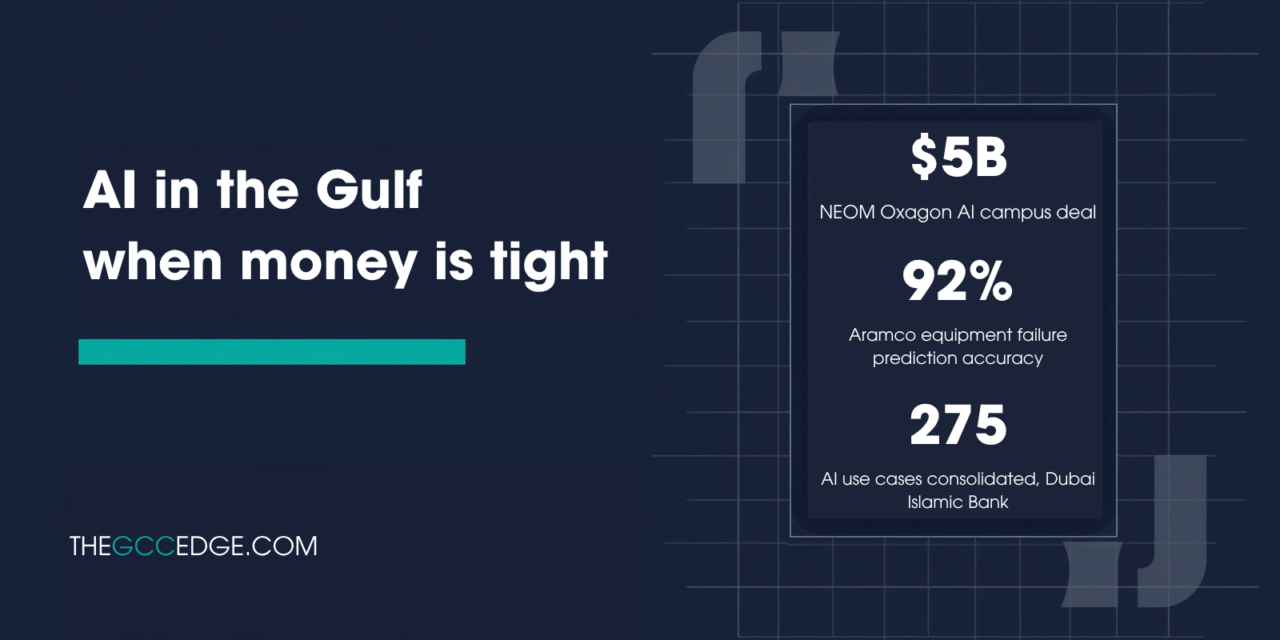
That capital is being redirected toward computing infrastructure. NEOM established a 5-billion-dollar partnership with DataVolt to build an AI data center campus in the Oxagon district, cooled by Red Sea seawater and designed for net-zero operations3. The Kingdom is also building a National Semiconductor Hub backed by a venture capital fund exceeding 266 million dollars, with 40 million dollars allocated to product development, aiming to attract 50 fabless chip design companies11.
Economic and Digital Infrastructure — Saudi Arabia vs UAE
| Metric | Saudi Arabia | United Arab Emirates |
| Projected Real GDP Growth (2025) | 3.8%7 | 4.8%7 |
| Six-Year Digital Infrastructure Investment | $24.8 Billion11 | State-backed sovereign clouds2 |
| Semiconductor Market Valuation | $6 Billion11 | Access via strategic partnerships |
| AI Share of 2030 Projected GDP | 12.4% ($135.2 Billion)13 | 14.0% ($44.8 Billion equivalent)13 |
| Major Capital Pivot | NEOM to Oxagon data centers3 | Federal budget expansion5 |
High-Latency Innovation and Non-Essential Digital Twins Face Budgetary Pauses
As budgets tighten, projects without a clear path to cost reduction within twelve months are being removed from active roadmaps4. High-memory generative AI models that struggle to show successful inference at an enterprise scale are among the first affected4. Centers that function as transactional execution units, processing requests without feeding strategy or building internal capability, are losing funding as enterprises require AI spending to connect directly to business outcomes27.
Long-term digital twin projects without immediate utility in urban or industrial management are also being deprioritized30. Regional stakeholders are redirecting those budgets toward smart city applications that offer measurable results, such as traffic optimization and energy consumption reduction, within the current planning cycle30.
Decision-Makers Pivot Toward 12-Month ROI and Sovereign Capability
The 2026 fiscal year is defining the era of the sovereign AI model for GCC decision-makers2. Strategic autonomy, which means owning the full technology stack from Arabic language models to physical data centers, is now prioritized over dependency on third-party hosted models2. Saudi Arabia’s 500-million-dollar sovereign cloud, built with Google and Oracle, ensures that public sector and oil and gas data remain within national borders2. The UAE’s Cyber Pulse program targets growth of the cybersecurity sector’s GDP contribution from 500 million dollars to over 2 billion dollars annually2.
To navigate the budget constraint, regional CIOs are turning Global Capability Centers into efficiency engines27. These centers, historically used for back-office support, now run autonomous workflows and AI-enabled processes in finance, human resources, and IT operations, allowing enterprises to generate productivity returns without overhauling legacy data architectures27,28. Dubai Islamic Bank, for example, consolidated more than 275 AI use cases into a single governed portfolio, standardizing model lifecycles and tracking financial value directly.29
Operational AI in Energy: Where the Numbers Hold
Within the energy sector, AI investments are protected because they produce documented cost savings and reduce asset downtime14. Since 2018, Saudi Aramco has invested more than 15 billion dollars in big data analytics, automation, and AI across its operations, analyzing approximately 10 billion data points daily and generating 4 billion dollars in technology-driven gains in 2024 alone17. Aramco’s AI-enabled predictive maintenance system monitors more than 50,000 critical pieces of equipment, predicting failures with 92 percent accuracy up to 60 days in advance.15
These systems have produced a 30 percent reduction in maintenance costs and a 35 to 40 percent decrease in unplanned downtime14. Aramco’s Artificial Lift Optimization system, which uses machine learning across 3,000 wells to adjust pumping parameters, raises productivity by 8 to 12 percent, cuts energy use by 15 percent, and adds 30 percent to equipment lifespan, generating 500 million dollars in annual value15. AI-assisted seismic analysis has also cut exploration costs by 40 to 50 percent.14
ADNOC’s technology joint venture, AIQ, developed ENERGYai in collaboration with G42, Microsoft, and SLB20. During a 90-day trial across 15 percent of ADNOC’s wells, the system’s seismic agent achieved a tenfold increase in interpretation speed and a 70 percent improvement in precision23. SLB joined as an implementation partner under a 340-million-dollar contract in August 2025, with full deployment in subsurface operations starting in late 202522. The system reduces geological modeling time by up to 75 percent and compresses planning cycles from two years to weeks.21
Enterprise AI — Documented Operational Savings
| Enterprise | Technology | Documented Result |
| Saudi Aramco | AI-enabled predictive maintenance15 | 30% maintenance cost reduction14 |
| Saudi Aramco | Artificial Lift well optimization15 | 15% energy reduction, $500M annual value15 |
| Saudi Aramco | AI-assisted seismic analysis14 | 40–50% exploration cost savings14 |
| ADNOC / AIQ | ENERGYai subsurface workflows22 | 10x seismic speed, 75% modeling time reduction21 |
| Dubai Islamic Bank | AI portfolio consolidation29 | 275 use cases rationalized into one governed portfolio29 |
What GCC Technology Leaders Should Do Now
The technology investment climate in the Gulf has moved from unconstrained experimentation to a phase of intense fiscal discipline2. The technologies that survive are those that provide immediate operational savings, protect physical and digital assets, and support national sovereignty2. For decision-makers, that means three coordinated actions.
First, consolidate digital initiatives into a single, value-tracked portfolio4. Projects without a clear path to cost reduction within twelve months should be deferred, freeing capital for operations with documented returns2. Dubai Islamic Bank’s governance model, which tracks financial value at the use-case level, is a replicable standard for any enterprise managing more than a dozen concurrent AI workstreams.29
Second, deploy Global Capability Centers as autonomous workflow engines rather than support desks27. Routing AI agents into established finance, HR, and IT processes generates immediate productivity returns without the delay of overhauling entire corporate database architectures.28
Third, build physical redundancy and digital sovereignty into all infrastructure designs from the outset2. Multi-availability zone security and sovereign cloud architecture are no longer optional features12. In a region where geopolitical shocks can interrupt operations within hours, the organizations that treat infrastructure security as a budget priority will be the ones that continue operating when others cannot.
References
[1] Ian Khan. “GCC Infrastructure Spend: What Gets Protected in Budgets.” https://www.iankhan.com/gcc-infrastructure-spend-what-gets-protected-in-budgets/
[2] ABHS. “The Line Is Cancelled: Saudi Arabia’s $50B NEOM Project Becomes an AI Data Centre.” https://www.abhs.in/blog/saudi-arabia-the-line-neom-cancelled-ai-data-center-pivot
[3] ABHS. “The Line Is Cancelled: Saudi Arabia’s $50B NEOM Project Becomes an AI Data Centre.” https://www.abhs.in/blog/saudi-arabia-the-line-neom-cancelled-ai-data-center-pivot
[4] PR Newswire. “AI Cost-Saving Efforts Stall Without Clear ROI, Finds Info-Tech Research Group.” https://www.prnewswire.com/news-releases/ai-cost-saving-efforts-stall-without-clear-roi-finds-info-tech-research-group-302728941.html
[5] WAM. “UAE Cements Position Among World’s Fastest-Growing Economies in 2025.” https://www.wam.ae/en/article/bn9cd5n-uae-cements-position-among-world’s-fastest-growing
[6] Oxford Economics. “Why Gulf Cities Are Strongly Positioned to Scale in the AI Value Chain.” https://www.oxfordeconomics.com/resource/why-gulf-cities-are-strongly-positioned-to-scale-in-the-ai-value-chain/
[7] Economy Middle East. “UAE Economy to Grow 4.8 Percent in 2025.” https://economymiddleeast.com/news/uae-economy-grow-4-8-percent-2025-balance-across-oil-non-oil-sectors/
[8] The National. “UAE’s Economy Grew 5.1% in First Nine Months of 2025 on Non-Oil Sector Boost.” https://www.thenationalnews.com/business/economy/2026/02/20/uaes-economy-grew-51-in-first-nine-months-of-2025-on-non-oil-sector-boost/
[9] ENR. “Cancelled Contracts Signal Rethink for Saudi Arabia’s $500B NEOM Megaproject.” https://www.enr.com/articles/62760-cancelled-contracts-signal-rethink-for-saudi-arabias-500b-neom-megaproject
[10] Construction Week. “Saudi Gigaprojects: All Cancelled NEOM Construction Contracts So Far.” https://www.constructionweekonline.com/gigaprojects/saudi-gigaprojects-neom
[11] Ken Research. “Saudi Arabia Semiconductor Market 2019–2030.” https://www.kenresearch.com/saudi-arabia-semiconductor-devices-market
[12] IDC. “First Look at the War in the Middle East and Its Impact on IT Spending.” https://www.idc.com/resource-center/blog/idc-point-of-view-first-look-at-the-war-in-the-middle-east-and-its-impact-on-it-spending-in-the-region-and-globally/
[13] PwC. “The Potential Impact of Artificial Intelligence in the Middle East.” https://www.pwc.com/m1/en/publications/potential-impact-artificial-intelligence-middle-east.html
[14] DigitalDefynd. “10 Ways Saudi Aramco Is Using AI.” https://digitaldefynd.com/IQ/saudi-aramco-using-ai/
[15] Date With Tech. “Saudi Aramco’s Digital Innovation and AI Implementation.” https://datewithtech.com/saudi-aramco-digital-transformation-ai-energy/
[17] Aramco. “Digitalization in the Oil and Gas Industry.” https://www.aramco.com/en/what-we-do/energy-innovation/digitalization
[18] AI Expert Network. “Case Study: Saudi Aramco Harnesses AI for Innovation.” https://aiexpert.network/case-study-saudi-aramco-harnesses-ai-for-innovation/
[19] ADNOC. “AI for Energy: How ADNOC Is Enhancing Operations with AI.” https://www.adnoc.ae/en/artificial-intelligence/ai-for-energy
[20] AIQ. “ENERGYai.” https://aiq.ae/products/AgenticAI/energyai
[21] AIQ. “ADNOC and AIQ Developing First-of-a-Kind Agentic AI Solution.” https://aiq.ae/newsroom/news-and-press-releases/ADNOC-and-AIQ-Developing-First-of-a-Kind-Agentic-AI-Solution-for-Global-Energy-Transformation
[22] SLB. “AIQ and SLB to Advance Development of Agentic AI Solution.” https://www.slb.com/newsroom/press-release/2025/aiq-slb-energyai-pr
[23] ADNOC. “ADNOC and AIQ Successfully Complete Trial Phase of Agentic AI Solution.” https://adnoc.ae/en/news-and-media/press-releases/2024/adnoc-and-aiq-successfully-complete-trial-phase-of-agentic-ai-solution/
[24] Risk Management Magazine. “The Impact of Federal Budget Cuts on Cyber Defenses.” https://www.rmmagazine.com/articles/article/2025/10/09/the-impact-of-federal-budget-cuts-on-cyber-defenses
[25] CIO Dive. “Most Finance Chiefs Expect Larger IT Budgets, Collapsing Staff Growth: Gartner.” https://www.ciodive.com/news/tech-budgets-cuts-2026-gartner/812385/
[26] Gartner. “Worldwide IT Spending to Grow 10.8% in 2026.” https://www.gartner.com/en/newsroom/press-releases/2026-02-03-gartner-forecasts-worldwide-it-spending-to-grow-10-point-8-percent-in-2026-totaling-6-point-15-trillion-dollars
[27] TestingXperts. “How AI Is Redefining Traditional GCC Cost Models.” https://www.testingxperts.com/blog/how-ai-is-redefining-traditional-gcc-cost-models/
[28] Forbes. “Trillions In, 2% Out: Getting AI Impact to Your Bottom Line.” https://www.forbes.com/councils/forbestechcouncil/2026/05/04/trillions-in-2-out-getting-ai-impact-to-your-bottom-line/
[29] HCLTech. “Enterprise AI Transformation for a Dubai-Based Bank.” https://www.hcltech.com/case-study/enterprise-ai-transformation-dubai-based-bank
[30] Gulf International Forum. “Gulf AI Infrastructure: Examining the Business and Economic Case.” https://gulfif.org/gulf-ai-infrastructure-examining-the-business-and-economic-case/
[31] Oxford Economics. “Why Gulf Cities Are Strongly Positioned to Scale in the AI Value Chain.” https://www.oxfordeconomics.com/resource/why-gulf-cities-are-strongly-positioned-to-scale-in-the-ai-value-chain/