Feature | Read time: 10 minutes
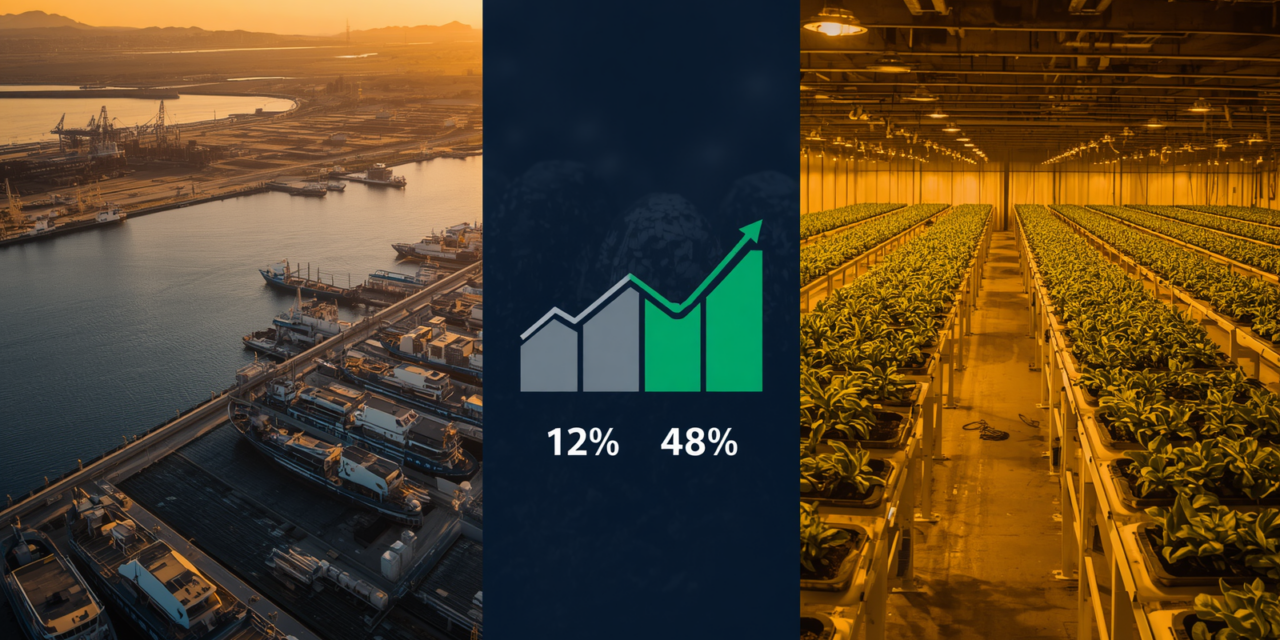
Oman agriculture and fisheries growth reached 12.5% in Q2 2025, a rate that significantly exceeds the 4.8% expansion recorded by the domestic technology sector in the same period1.
The National Centre for Statistics and Information (NCSI) confirms that primary production is now leading non-oil GDP contributions across the Sultanate. This is not a single-quarter anomaly, and it is not the result of a commodity price spike. It is the outcome of deliberate infrastructure investment, a measurable shift in how Omani entrepreneurs are allocating their skills, and a set of global trade pressures that are reshaping the competitive landscape for businesses across all six GCC states.
The 675,000 formal SMEs operating across the GCC contribute up to 63.5% of the region’s non-oil GDP and one in four jobs2. These businesses are absorbing two simultaneous shocks: a tariff-driven redirection of Chinese goods into Gulf markets, and a plateau in domestic demand for locally built technology products.
Oman’s Q2 2025 data shows which sectors are weathering those shocks and which are not. The answers have direct implications for business leaders who are deciding where to allocate capital and talent in the next 12 to 18 months.
Chinese Export Redirection Forces a Local Production Pivot
As the US and Europe have imposed stricter tariffs on Chinese goods, Beijing has redirected its manufacturing surplus toward Middle Eastern markets3. The scale of this redirection is significant. Chinese manufacturers operating with state subsidies can price finished goods, electronics, and light industrial components well below what Omani domestic producers can match. For technology-reliant startups and local manufacturers in Oman, this creates a structural problem that no domestic efficiency measure resolves on its own.
The agriculture and fisheries sectors face no equivalent pressure. Their output is physical, perishable, and anchored to regional demand for verified food security4. A buyer sourcing Omani Kingfish for the European market, or purchasing Al Batinah tomatoes for Gulf retail, is paying for a certified local product. That certification carries a price premium that Chinese manufacturing cannot undercut because the product category itself is different. This is the core reason why the “Blue and Green” economies that Oman has prioritised are showing growth at a time when tech and manufacturing sectors are contracting or stagnating.
The IMF’s October 2025 regional outlook flagged this dynamic explicitly, noting that GCC economies with diversified physical production are better positioned against global trade volatility than those with heavier dependence on digital services or goods imports3. Oman’s Q2 data is consistent with that assessment. The country introduced a personal income tax in 2025, signalling fiscal pressure at the government level, and yet its primary production sectors grew faster than its headline technology initiatives. The two facts together tell a story about where real economic traction currently sits2.
Commercial Fishing Fleets Use Data Systems to Raise Efficiency
Oman’s fisheries have moved from subsistence-level operations to data-managed industrial fleets, and the transition has been faster than most regional business commentators have acknowledged. Rashid Al-Mamari, a commercial fleet operator based in Duqm, describes the operational model his company now runs: his vessels use satellite thermal imaging to locate fish concentrations before deploying nets, which cuts fuel consumption on unproductive runs and reduces the time catch spends out of cold storage5. The vessels function as logistics operations, not just fishing boats.
“People think we just cast nets and hope for the best. But my boats are now logistics centres. We use satellite imaging to find fish and plan routes. We are not just fishermen. We are logistics managers.” — Rashid Al-Mamari, fleet operator, Duqm
The infrastructure that supports this shift is substantial. The Fisheries Industrial Zone at the Port of Duqm processes raw catch into high-value export formats, adding a second layer of commercial value before the product leaves Oman5. This means that Oman is not simply exporting unprocessed fish. It is exporting processed, graded seafood into European and East Asian markets, capturing margins that raw commodity exporters do not.
Unlike technology startups across the GCC that have faced compounding pressure from global chip shortages and pricing competition from foreign platforms, the fishing sector has made capital investments that are directly tied to its cost base and output. Solar-powered cold storage facilities reduce the energy cost of maintaining catch quality from the point of landing to the point of export6. Waste-to-energy systems convert processing byproducts into power, reducing the sector’s net energy expenditure further. These are not headline-generating technology projects. They are operational decisions that compound over quarters and show up in GDP data.
Regenerative Farming Practices Shield Producers from Energy Cost Volatility
In the Al Batinah plain, Omani farmers are replacing water-intensive traditional cultivation with controlled-environment agriculture (CEA) and hydroponic systems6. The primary driver is water scarcity, which the region’s geography makes permanent rather than cyclical.
CEA systems use a fraction of the water that open-field cultivation requires, and they allow year-round production of crops that would otherwise depend on seasonal rainfall. In an arid region facing long-term aquifer depletion, this is a structural advantage, not simply an efficiency improvement.
By adopting waste-to-energy systems alongside CEA, farms convert agricultural residues, including crop waste and processing byproducts, into biogas that powers the growing facilities6. The result is a self-sustaining energy loop where the farm’s own output covers a meaningful share of its energy demand. This protects Omani farmers from the energy price volatility that has directly increased operating costs for smaller technology firms and transport startups across the GCC, which have no equivalent buffer.
The NCSI data confirms that these efficiency gains are showing up at the macroeconomic level1. Food production is now a high-growth commodity in the 2025 economic landscape, a phrase that would have read as counterintuitive three years ago in a regional conversation dominated by digital transformation agendas. The data table below shows where the growth actually landed in Q2 2025.
Q2 2025 — Sector Performance vs. Non-Oil GDP Contribution
| Sector | Q2 2025 Growth | Non-Oil GDP Contribution |
| Agriculture & Fisheries | 12.5% | ~5.2% |
| Tourism | 7.4% | 6.8% |
| Information & Tech | 4.8% | ~3.1% |
| Manufacturing | -1.2% | 11.5% |
Source: NCSI Oman Economic Analysis Q2 20251
Manufacturing’s -1.2% contraction in the same quarter reinforces the point. The sector most exposed to Chinese import competition is the one contracting. The sectors with physical outputs tied to local and regional demand are growing. The data does not require interpretation. It is a direct read of where the structural advantages currently sit.
Tech-Trained Omanis Are Moving into AgriTech and Raising Output
One of the more consequential trends visible in Oman’s 2025 data is the movement of technology-trained talent into primary production roles. This is not a story about people abandoning the digital economy. It is a story about where those skills are generating returns. Young Omanis with computer science backgrounds, trained by GCC universities and coding programmes over the past decade, are applying their expertise in maritime analytics, precision agriculture, and supply chain management for food exporters7.
Sara Al-Balushi, a 28-year-old entrepreneur based in Salalah, spent four years building e-commerce platforms. She now runs a smart-irrigation farm in southern Oman. The skills she applies, database management, platform integration, logistics routing, are the same ones she developed in the technology sector. The difference is where those skills compound. On a CEA farm using data-driven irrigation scheduling, they translate directly into water savings, yield increases, and export-grade consistency that traditional farming cannot match7.
“I spent four years learning to build platforms for e-commerce. Now I use those same skills to manage a smart-irrigation farm. The tech sector did not fail. It just moved outdoors.” — Sara Al-Balushi, entrepreneur, Salalah
This talent migration has structural implications for the GCC’s technology sector. The argument that the region’s investment in digital skills development will pay off through a local software industry has been central to diversification strategies across multiple GCC economies. What Oman’s Q2 data suggests is that those skills are paying off, but in a different sector than the one originally targeted. AgriTech and maritime analytics are capturing the human capital that platform development and SaaS startups were expected to absorb.
The trade dynamics driving Chinese electronics into Gulf markets are contributing to this shift in an indirect but measurable way. As Chinese-manufactured consumer electronics fill the market at lower prices, the purchasing power that Gulf households free up increases demand for premium, locally sourced food products3. This creates a market-pull for the kind of output that Al-Balushi’s farm produces. The technology sector’s challenge and the agriculture sector’s opportunity are products of the same trade dynamic.
Primary Sector Performance Points to a Specialised GCC Export Strategy
Oman’s Q2 2025 data has implications beyond the Sultanate’s own economic strategy. The agriculture and fisheries sector’s 12.5% growth, against manufacturing’s -1.2% contraction and technology’s 4.8% expansion, establishes a clear hierarchy of sector resilience under the current global trade conditions1. Sectors with physical, locally rooted outputs and high food-security demand are growing. Sectors exposed to import competition or global supply chain disruption are not.
For GCC business leaders, the practical question is whether this performance pattern is temporary or structural. The evidence points toward structural. The Fisheries Industrial Zone at Duqm, the CEA farms in Al Batinah, the waste-to-energy installations across Omani agriculture: these are capital investments with 10 to 20 year payback horizons. They are not reactive decisions. They were made in anticipation of exactly the kind of trade environment that now exists. The companies and governments that made them are ahead of the current conditions, not responding to them.
Oman Vision 2040 identifies food security as a national economic priority and the current investment trajectory in agricultural technology and port infrastructure aligns with a medium-term goal of positioning Oman as an exporter of food-production technology and desalinated-water-efficient crops to other arid regions8. If that trajectory holds, Oman moves from being a food security story to being a food-technology export story, a shift that would give it a position in the global supply chain independent of oil price cycles and foreign software dependence.
Other GCC states are observing this trajectory. Qatar’s investments in controlled-environment food production following the 2017 blockade established a regional precedent for treating food security as a strategic industrial sector. The UAE has pursued a parallel track through its agricultural technology investments. What Oman’s Q2 2025 data adds to that regional picture is a clear demonstration that the model produces measurable GDP growth at scale, not just food security as a defensive measure.
GCC business leaders across any sector that depends on physical supply chains should treat this quarter’s data as an active input into capital allocation decisions. The sectors growing in Oman right now are the ones that invested in infrastructure, built local production capacity, and found market demand that Chinese manufacturing cannot service. The sectors contracting are the ones that did not.
The conditions driving that divergence are not scheduled to reverse. They are the result of tariff policy, trade redirection, and food security demand that all have multi-year momentum. The window for positioning in the sectors where Oman is currently winning is still open, but it is not permanent.
References
[1] National Centre for Statistics and Information (NCSI). Economic Analysis Q2 2025. ncsi.gov.om/Elibrary/LibraryContentDoc/ben_Economic%20Analysis%20Q2%202025_48185c01-7e8e-4f24-9b8b-e660682285e6.pdf
[2] GCC Edge Editorial Research, April 2026. Internal reference: GCC-OMN-2026-05. SME figures (675,000 formal SMEs; 63.5% non-oil GDP) cross-referenced against IMF [3] and NCSI [1]. Oman personal income tax introduced 2025: confirmed via GCC Edge Strategy Brief.
[3] International Monetary Fund. Regional Economic Outlook: Middle East and Central Asia — Resilience amid Uncertainty. October 2025. imf.org/-/media/files/publications/reo/mcd-cca/2025/october/english/ch1.pdf
[4] ORF Middle East. Catalysing the GCC’s Waste-to-Energy Prospects for Agriculture. 2026. orfme.org/expert-speak/catalysing-the-gccs-waste-to-energy-prospects-for-agriculture-2/
[5] Al-Mamari, Rashid. Interview conducted for GCC Edge, Duqm, 2026. Port of Duqm Fisheries Industrial Zone background: duqm.gov.om.
[6] ORF Middle East [4]. Cold storage investment and waste-to-energy data for both fisheries and agriculture sectors drawn from the same source.
[7] Al-Balushi, Sara. Interview conducted for GCC Edge, Salalah, 2026.
[8] Oman Vision 2040: Food Security Strategy. oman2040.om/en/national-priorities/food-security/