For many senior executives in the UAE, the working day does not start at the office. It starts on the E11.
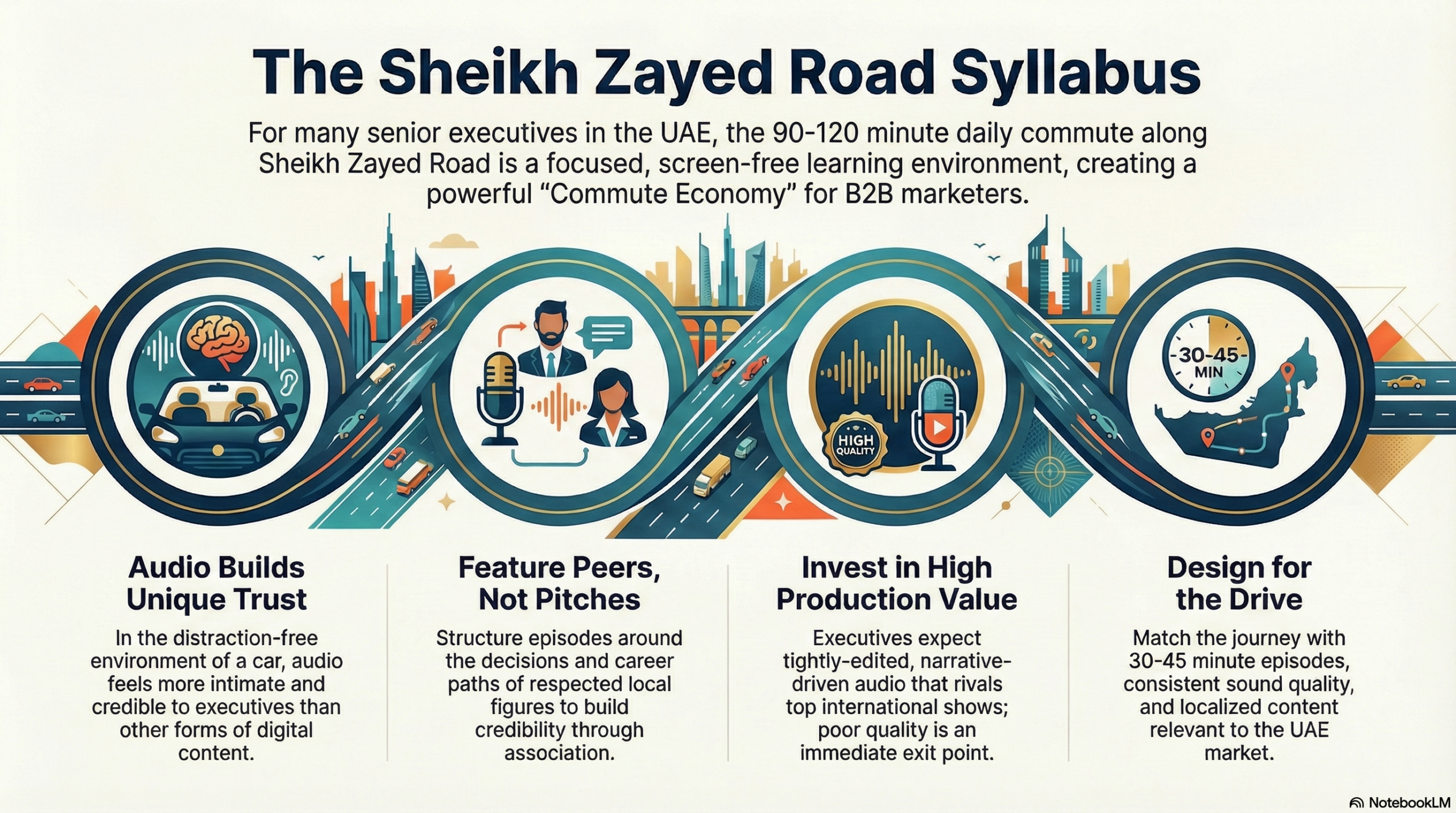
The daily drive along Sheikh Zayed Road, connecting Dubai’s commercial districts with Abu Dhabi’s government and enterprise centers, is not a marginal routine. It is a fixed block of time that often stretches from 90 minutes to two hours. This window is repeated five days a week, year after year.
What has changed is how that time is used.
In 2025, the UAE commute has become a private learning environment. Music and radio still exist, but a growing share of senior professionals now use the drive for long-form audio focused on business, leadership, and policy.
For B2B marketers, this shift creates a rare condition, sustained attention from decision-makers who are not scrolling, skimming, or multitasking across screens.
This is the Commute Economy, and audio is its primary channel.
Why Audio Earns Trust During the Commute
Audio performs differently from visual content, especially in the context of driving. It is not competing with notifications, emails, or feeds. It is experienced alone, through headphones or a car sound system, with limited interruption.
Research across the Middle East shows a growing credibility gap between audio and other media formats. A majority of listeners report that podcasts feel as credible as, or more credible than, traditional broadcast media. In the UAE, regular podcast listeners consistently state higher trust in audio compared to short-form digital content.
There are three reasons this trust forms so reliably during the commute.
First, audio creates intimacy. A single voice, heard consistently, feels closer to a conversation than a broadcast. Over time, familiarity builds credibility.
Second, listening signals intent. Choosing a long-form business podcast during a commute reinforces a sense of purpose and self-improvement, which aligns closely with the professional culture of the UAE.
Third, audio removes performance. There is no visual staging, no slides, and no on-screen posturing. What remains is clarity of thought and quality of storytelling. Weak ideas are exposed quickly.
For senior audiences, this combination matters.
Why Most B2B Podcasts Fail with UAE Executives
Many B2B brands misunderstand what it means to produce audio.
Recording a video call and uploading the audio is not a podcast strategy. Low production quality, uneven sound, and unstructured conversation signal a lack of seriousness. For an audience that consumes premium global content, this is an immediate exit point.
Executives in the UAE regularly listen to well-produced international shows with clear narrative structure, tight editing, and strong pacing. They expect similar standards from regional content.
This is why documentary-style audio performs better than interview transcripts disguised as podcasts.
Narrative audio uses structure. It is scripted, edited, and designed to hold attention across an entire commute. Sound design supports the story instead of distracting from it. Episodes are built around a central idea, not a calendar booking.
GE Vernova offers a useful reference point, even though their best-known work is in film. Their storytelling focuses on people, decisions, and consequences rather than product specifications. The same principle applies to audio. Executives stay engaged when content explains how progress happens, not when it lists features.
In the Middle East, networks like Kerning Cultures have demonstrated that immersive, well-produced audio can sustain attention across long listening sessions. The lesson for B2B brands is clear. Production quality is not optional. It is part of the message.
Using Peer Credibility as the Core Narrative Engine
Business in the Gulf is relationship-driven. Reputation travels faster than messaging, and credibility is often established socially before it is established commercially.
Effective B2B audio formats reflect this reality by centering episodes on peer experience.
Senior leaders are not interested in abstract frameworks. They want to hear how others navigated regulation, market volatility, organizational pressure, and growth inside the UAE. They want context, not theory.
Structuring episodes around the career paths and decisions of respected local figures allows the audience to learn without being sold to. The host brand benefits by association. By creating a platform where respected voices speak openly, the brand becomes a convener rather than a vendor.
This is where audio creates a form of social transfer. Hosting a credible figure allows some of that credibility to reflect back onto the platform itself. Over time, the brand becomes part of the professional landscape rather than an external advertiser.
Executing an Audio Strategy That Fits the UAE Commute
Capturing the commute requires deliberate design choices.
Episode length should match the journey. For most Sheikh Zayed Road commuters, 30 to 45 minutes fits naturally. Shorter episodes increase friction, as listeners must interact with their device while driving. Longer episodes risk being abandoned before completion.
Sound quality must be consistent. Clear vocal recording, balanced levels, and thoughtful editing communicate seriousness. A simple but recognizable audio identity helps signal quality within seconds.
Content must be localized. Global trends only matter when explained through UAE realities. Referencing local regulation, economic initiatives, sector shifts, or recent events signals that the content is produced from within the region, not adapted for it.
Finally, distribution should respect listening habits. Regular release schedules and predictable formats matter more than volume. Consistency builds trust.
The Strategic Payoff
The UAE commute is not idle time. It is a recurring window of focused attention from some of the most influential professionals in the region.
Brands that treat this audience as passive targets will fail. Brands that respect them as peers, invest in production quality, and tell relevant local stories can build authority that no display campaign can replicate.
In the Commute Economy, attention is not captured by noise. It is earned through clarity, credibility, and restraint.