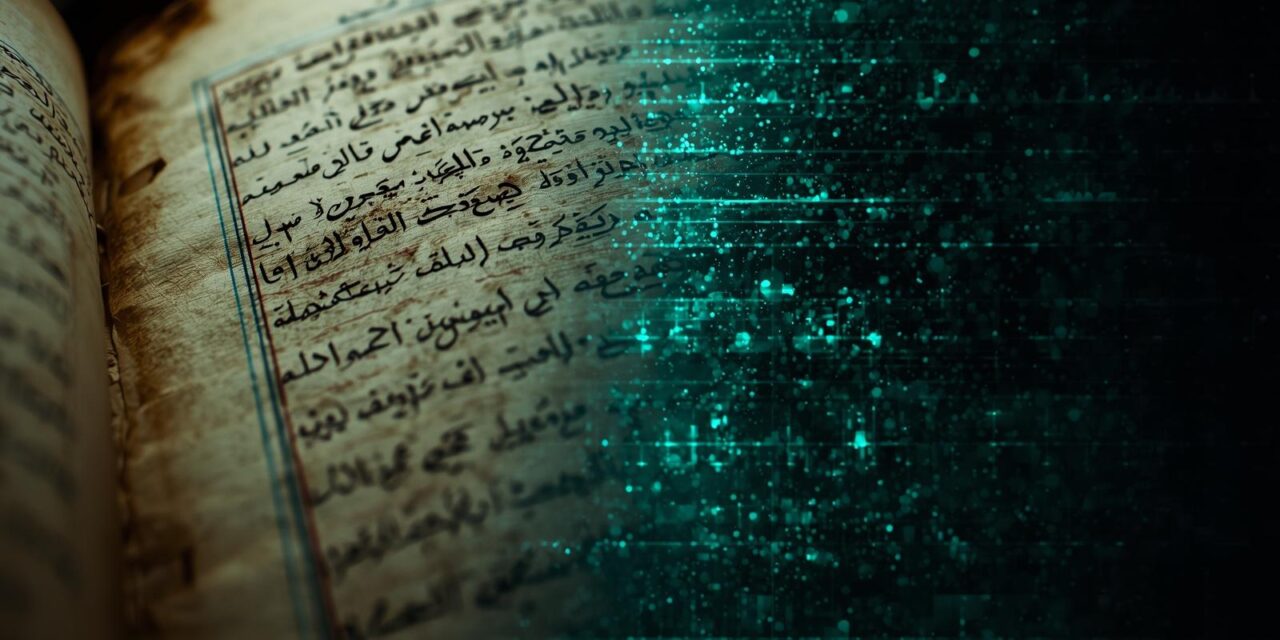
Oman’s written history is vast, spanning centuries of intellectual, political, and cultural documentation stored in rare and often fragile manuscripts.
The race to preserve this heritage is urgent, as these irreplaceable texts are vulnerable to degradation and permanent loss. To confront this monumental task, Oman is not relying solely on manual labor; it is strategically deploying Artificial Intelligence (AI) to serve as the efficient, tireless librarian of the future.
The goal is twofold: to protect the physical documents through digital archiving and to unlock their profound historical knowledge by making them fully searchable and accessible to scholars worldwide.
The Scale of the Challenge: Unique Scripts and Fragile Texts
The digitization of manuscripts is fundamental to securing Oman’s written heritage. However, ancient Omani texts present unique challenges that standard global technologies cannot easily resolve:
- Handwritten Variability: Unlike printed texts, manuscripts exhibit unique handwriting styles, which are often complicated by age, damage, or fading. Standard Optical Character Recognition (OCR) tools often fail when faced with these complexities.
- Labor-Intensive Annotation: Traditional digitization requires expert human labor to catalog, annotate, and transcribe every page—a process that is slow and resource-intensive, particularly for large-scale national collections.
Recognizing these limitations, Oman is embracing AI and deep learning to significantly enhance the efficiency and scholarly authenticity of its preservation pipeline.
The AI-Driven Digitization Pipeline
Oman’s strategy involves a sophisticated, multi-stage application of machine learning technology:
1. Advanced Imaging and Processing
The process begins not with transcription, but with high-fidelity capture. Techniques involve advanced technologies such as high-resolution imaging with adaptive lighting, which is crucial for distinguishing faded or damaged script from the paper itself. Deep learning is then applied to these images for pre-processing, ensuring maximum quality and clarity before transcription even begins.
2. Handwritten Text Recognition (HTR)
This is where AI provides the most significant breakthrough. Instead of using generic software, the digitization pipeline leverages Handwritten Text Recognition (HTR) engines that can be trained on specific Omani manuscript samples. This tailoring allows the system to overcome the limitations of generic OCR, adapting its performance to unique regional handwriting styles and historical scripts. By building localized technological capacity, Oman ensures that its AI speaks fluent Omani paleography. This adaptability is vital for accurately interpreting rare writings where external pre-trained systems would inevitably fail.
3. AI for Restoration and Indexing
Beyond simple transcription, AI tools are also critical in the painstaking effort of restoring damaged or worn-out texts. Deep learning techniques can assist in filling gaps and correcting distortions, augmenting the work of human cultural historians and restorers.
The technology acts as a crucial acceleration multiplier. By augmenting human efforts in labor-intensive tasks like initial transcription and validation, AI enables preservation teams to secure a significantly greater volume of the nation’s historical texts much faster, mitigating the risk of degradation or permanent loss over time.
Building Local Technological Capacity
Oman’s commitment to localized technological development is essential to this strategy.
Projects like the establishment of the Artificial Intelligence Studio and the development of the Omani Large Language Model “Maeen” are designed to support sophisticated cultural applications like manuscript preservation.
This localized focus ensures that technology is not a generic, imported solution but a precision tool custom-built for the unique linguistic and historical challenges of Omani heritage. It ensures that the interpretation and classification of digitized texts are handled with scholarly authenticity and cultural nuance.
Collaboration: The Human-AI Partnership
The successful digitization of written heritage hinges on a strategic collaboration between technology specialists and cultural experts. While AI excels at speed, pattern recognition, and volume processing, human expertise remains irreplaceable in tasks requiring nuanced contextual understanding—such as interpreting marginal annotations, clustering entries with specialized definitions, or validating the final output.
This balanced approach, combining the scalability of machine learning with the interpretive depth of human expertise, is setting an international standard. It proves that AI’s greatest value in cultural preservation is not replacement, but enhancement, establishing a forward-thinking strategy for integrating modernity with enduring historical influences.
By embracing AI, Oman is transforming its vast collection of rare manuscripts from vulnerable, inaccessible artifacts into a secure, dynamic, and globally shared knowledge base, ensuring its written legacy informs the generations of the future.