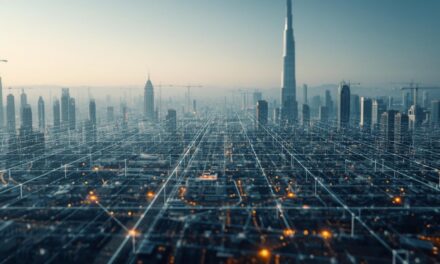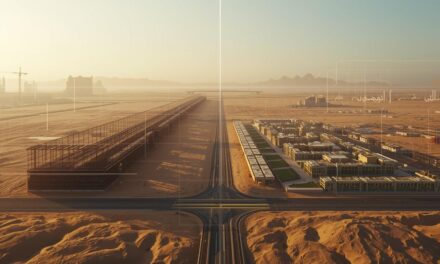
The Gulf Cooperation Council is reshaping its economic future by building new cities and testing new models of urban development.
Some countries prefer large, high-profile projects built from scratch. Others are adopting slower, phased models that adjust to real conditions.
A close look at Saudi Arabia’s The Line and Abu Dhabi’s Masdar City shows the difference between ambition that depends on perfect execution and ambition that grows through iterative development.
The Line, Ambition at a National Scale
The Line is the core of the five hundred billion dollar NEOM program in Saudi Arabia. It was announced as a new form of urban living that removes cars, reduces emissions, and compresses nine million people into a single continuous structure. The concept demanded rapid delivery and a full build out within a tight timeline.
The project has since shifted to a longer schedule. Completion has moved to 2045. This is a direct acknowledgement of the engineering and logistical complexity. Construction is active, but progress remains limited. By late 2025, only 2.4 kilometers of the planned structure were in place.
Financing pressures have also emerged. The Public Investment Fund is still committed to NEOM, but the reported eight billion dollar write-down signals a growing recognition of risk. Large contracting packages, supply chain constraints, and extended timelines increase the financial burden on a single national investor.
The project still carries strategic value for Saudi Arabia, but it now depends on controlled pacing rather than accelerated expansion.
Masdar City, A Model Built Through Adjustment
Masdar City began in 2006 with the claim of becoming the first fully zero-carbon urban district. That goal was not reached.
By 2016 the project had reached only half of its target. The physical footprint is still small, covering less than one sixth of its planned area, with around fifteen thousand workers and residents.
This slow delivery has produced a more stable result. Masdar City has evolved into a focused research and development community with a clear commercial purpose. Its buildings consume about 40 percent less energy and water than standard structures in the region. Its ten megawatt solar plant and rooftop panels displace fifteen thousand tonnes of carbon dioxide each year. The upcoming MC2 extension continues this pattern, targeting net zero energy performance within a practical, buildable format.
Masdar City now functions as a test bed for applied sustainability rather than a fully predetermined vision. This shift has made it more resilient. Adjustments occur based on financial conditions, tenant needs, and policy changes. Progress is slower, but each stage is grounded in operational learning.
Execution Models Show the Real Difference
The gap between the two cities is not about ideology. It is about how complexity is managed.
The Line depends on a single, very large delivery stage that requires stable financing, rapid mobilization, and aligned engineering partners. Any delay or budget adjustment affects the entire structure. Masdar City uses small, modular stages that can be paused, updated, or redesigned without compromising the rest of the project.
This difference matters because Gulf megaprojects operate within fluctuating global markets, changing technology costs, and evolving sustainability standards. A phased approach offers more control over risk, especially when public funds carry the bulk of investment responsibility.
Why Digitization Strengthens Urban Development
The most consistent improvements in GCC cities now come from digital upgrades to existing systems.
Dubai provides a clear example. With 99.5 percent of government services digitized and a fully paperless operating model, the city has advanced without rebuilding its physical structure.
This model builds institutional capability by improving data processes, service delivery, and operational management. It also creates a foundation that supports future urban development, whether new or existing.
The lesson is straightforward. Cities that invest in digital capacity before structural transformation gain more predictable results. They learn how to manage complex systems and can apply those skills to larger urban plans.
Conclusion
The comparison between The Line and Masdar City highlights the difference between rapid, high-stakes transformation and patient, staged development.
The region will continue to pursue bold ideas, but long term success depends on how well those ideas are delivered.
Phased models, supported by strong digital capability and continuous operational learning, remain the most reliable path for GCC cities preparing for the future.