Saudi Arabia’s ambition to build a globally competitive electric vehicle industry was never about assembling cars for the domestic market. It was about proving that the Kingdom could design, engineer, and industrialize a complex product at global standards, on its own terms. Ceer Motors is the clearest expression of that ambition to date.
Positioned as Saudi Arabia’s first homegrown EV brand, Ceer has been deliberately constructed as a national champion, not in name, but in design logic. Every layer of the company, from brand identity and engineering partnerships to climate-specific hardware and local supply chains, reflects a strategic intent to anchor advanced manufacturing inside the Kingdom. This is not a lifestyle brand experiment or a rebadging exercise. It is an attempt to compress decades of automotive learning into a single, sovereign-led platform.
What makes Ceer worth examining is not that it exists, but how it has been built. By combining BMW-derived component architectures, Foxconn’s electronics and production expertise, and engineering optimized for the realities of Gulf driving, Ceer offers a case study in how emerging economies can enter capital-intensive industries without repeating past failures.
For MENA drivers, it is positioned as a vehicle designed for local conditions. For Saudi Arabia, it is a real test of whether industrial policy can translate into durable manufacturing capability.
Why “National Champion” Matters in Automotive Strategy
In industrial policy, a national champion is not simply a domestic brand protected by the state. It is a company designed to internalize knowledge, develop supply chains, and build exportable competence over time. Automotive manufacturing is one of the most demanding environments for this approach, given its capital intensity, regulatory complexity, and long product cycles.
Saudi Arabia’s choice to pursue EV manufacturing is strategic. Electric platforms reduce mechanical complexity compared to internal combustion vehicles and shift value toward software, electronics, thermal management, and systems integration. These are areas where partnerships and modular learning can shorten the path to competitiveness.
Ceer’s mandate fits squarely within this logic. It is intended to anchor an automotive ecosystem, not just sell vehicles. Success will be measured less by first-year sales figures and more by how much engineering capability, supplier depth, and production expertise remain in the Kingdom a decade from now.
Collapsing Barriers to Entry Through Global Partnerships
Rather than attempting to build everything internally from day one, Ceer was structured to collapse the most difficult barriers to entry through targeted partnerships.
The Public Investment Fund acts as the financial and strategic backbone. Its role is not limited to capital provision, but extends to long-term coordination across suppliers, training institutions, and industrial zones. This gives Ceer a planning horizon that private startups rarely have.
BMW’s contribution comes in the form of licensed component architectures. This provides a proven engineering foundation, reducing development risk while allowing Ceer to focus resources on integration, localization, and platform optimization. Importantly, this is not a brand-sharing arrangement, which preserves Ceer’s identity and strategic autonomy.
Foxconn brings expertise in electronics architecture, digital systems, and production scaling. As vehicles become increasingly software-defined, this capability is critical. Foxconn’s experience in managing complex supply chains and high-volume production is directly applicable to modern EV platforms.
Together, this partnership model avoids a common pitfall of national auto projects, which often try to reinvent mature systems from scratch or rely too heavily on contract manufacturing without absorbing knowledge.
Designing Cultural Identity Into a Global Product
Ceer’s branding decisions reflect a deliberate effort to embed national identity without sacrificing international credibility.
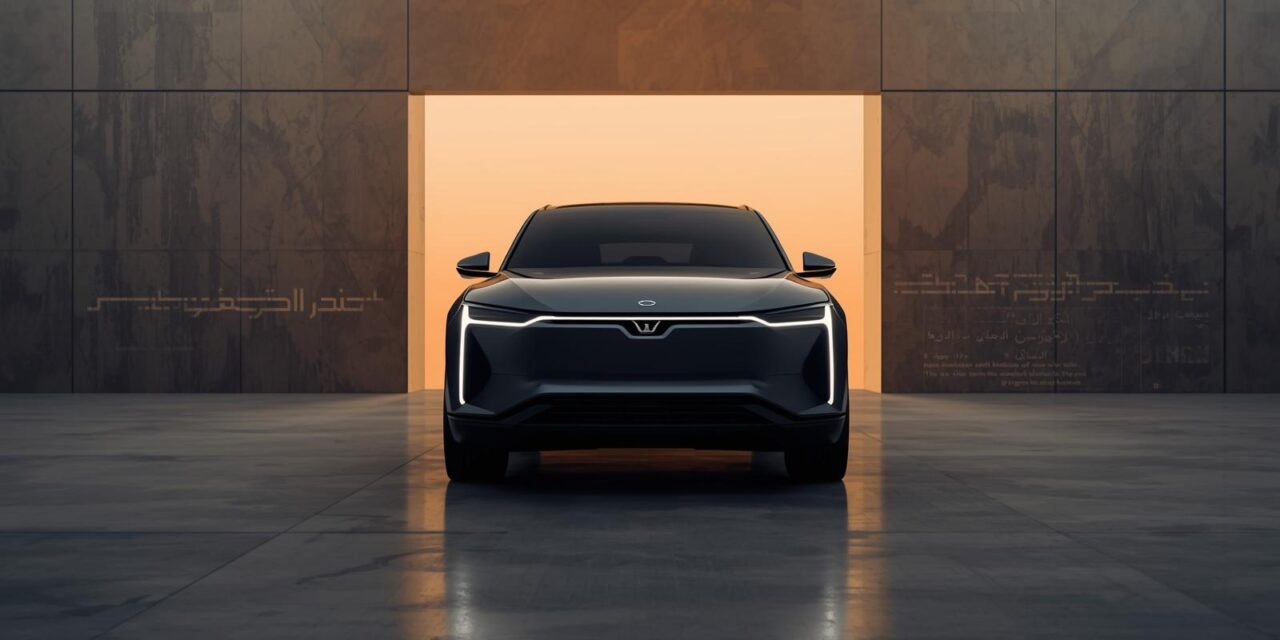
The bilingual Arabic-English logotype, unveiled on Saudi National Day, is a first in the global automotive industry. It signals confidence in local language and culture while acknowledging the global nature of the EV market. This is not ornamental branding. It establishes Ceer as a Saudi company designed for export visibility as well as domestic pride.
The visual identity extends into product design through the use of 32 distinctive light bars across the vehicle portfolio. This reference to 1932, the year of Saudi unification, functions as a consistent design system rather than a one-off motif. It gives Ceer vehicles immediate recognizability without resorting to overt national symbolism that might limit international appeal.
This balance between cultural specificity and global design discipline is critical if Ceer is to operate beyond its home market.
Engineering for the GCC, Not Retrofitting for It
Many global vehicles sold in the Gulf are adapted versions of platforms designed for temperate climates. Ceer has taken the opposite approach, engineering for extreme heat and usage patterns from the outset.
A central example is the integrated three-in-one drive system supplied by Hyundai Transys. By combining the motor, inverter, and reduction gear into a single unit, Ceer reduces energy losses, improves thermal efficiency, and enhances reliability under sustained high loads. These factors matter in a region where long-distance driving and high ambient temperatures are normal, not edge cases.
Thermal management extends into the cabin. Through a partnership with Isoclima, Ceer vehicles will feature what is described as the world’s largest automotive windshield, produced with ultra-thin infrared-reflective coatings. This technology directly reduces solar heat gain, lowering air conditioning demand and preserving battery range. In a 50°C environment, this is a functional requirement, not a luxury feature.
By addressing these constraints at the platform level, Ceer avoids the compromises that often undermine EV performance in the GCC.
Manufacturing as a Competitive Advantage
Ceer’s manufacturing strategy reinforces its premium and customization ambitions. At the Ceer Manufacturing Complex in King Abdullah Economic City, the company is installing an advanced paint facility developed with Dürr.
Unlike traditional linear paint shops, this modular system allows for flexible configurations and high degrees of customization. Overspray-free technology enables simultaneous two-tone finishes, a feature that aligns closely with Gulf consumer preferences for visual distinction and personalization.
More importantly, this flexibility allows Ceer to adapt production over time as models evolve and export requirements change. Manufacturing is treated as a strategic asset rather than a fixed cost center.
Economic and Workforce Implications
Ceer’s impact extends beyond vehicle output. It is a core pillar of the King Salman Automotive Cluster and is projected to contribute $8 billion in direct GDP by 2034.
The company is expected to support up to 30,000 direct and indirect jobs across engineering, manufacturing, and supplier networks. Localization is a central objective, with more than SAR 5.5 billion in supplier agreements already signed and over 80 percent awarded to Saudi-based firms to meet a 45 percent local content target.
Talent development is being addressed through partnerships with institutions such as the National Automotive and Vehicles Academy. Specialized diploma programs are intended to create a steady pipeline of skilled technicians and engineers, ensuring that capability development keeps pace with physical infrastructure.
Risks and Market Realities
Despite its strong foundation, Ceer faces clear execution risks. Imported EV brands already dominate the GCC market, with established reputations, pricing power, and charging ecosystems. Competing with them will require careful positioning, particularly on price, perceived quality, and after-sales support.
Scale is another challenge. Domestic demand alone may not justify long-term production volumes, making export viability essential. This places pressure on Ceer to meet international regulatory standards and compete in crowded global segments.
Finally, the transition from industrial vision to operational excellence is where many national projects falter. Delivery timelines, quality control, and customer experience will ultimately determine credibility.
Conclusion: A Test Case for Post-Oil Manufacturing
Ceer Motors represents one of the most serious attempts in the region to build an advanced manufacturing capability from the ground up. It combines global expertise with local intent, and policy ambition with engineering discipline.
If successful, Ceer will demonstrate that Saudi Arabia can move beyond resource extraction into complex, export-oriented manufacturing. If it falls short, it will still provide valuable lessons about the limits and requirements of industrial transformation.
Either way, Ceer is not just a new car brand. It is a test case for how the Kingdom intends to compete in a post-oil industrial economy.