
Category: Business

The $27 Trillion Liquidity Problem in Global Trade
An estimated $27 trillion sits idle in global correspondent banking accounts. Learn how CBDC settlement platforms and GCC financial initiatives could reduce prefunding and improve capital efficiency in cross-border trade.
Read More
How Saudi Arabia and the UAE Are Rebuilding Capital Markets On-Chain
An in-depth analysis of GCC real-world asset tokenization, covering blockchain property registries, renewable energy financing, digital sukuk, and CBDC integration.
Read More
Ceer Motors and the Logic of a Saudi “National Champion”
Ceer Motors is not just Saudi Arabia’s first EV brand. It is a deliberate attempt to build advanced automotive manufacturing capability inside the Kingdom, on its own terms.
Read More
The Economic Paradox Behind EV Ownership in the Gulf
Electric vehicles in the Gulf are meant to be cheaper to own. Yet for many drivers, rising insurance premiums and high repair costs are offsetting the savings from low charging prices. This article explains why EV economics in the UAE look very different from what early adopters expected.
Read More
The Law vs. the Market: What Qatar and Kuwait Reveal About Women Entrepreneurship in the Gulf
Qatar has built one of the most legally equal systems for women entrepreneurs in the world. Kuwait has not. Yet in practice, Kuwaiti women lead startups at far higher rates. This article examines why legal reform alone does not guarantee economic participation, and what the contrast between Qatar and Kuwait reveals about how markets, culture, and policy interact across the Gulf.
Read More
The Financing Gap Shaping Gulf Women Entrepreneurs
For women founders in the Gulf, geography shapes survival. In Kuwait, self-funding forces speed, sales, and commercial focus. In Qatar, state-backed grants make long development cycles possible. These two paths explain why women-led startups across the region look so different, and why many struggle to scale.
Read More
From Black Gold to White Oil: Saudi Arabia’s Race to Control the Battery Midstream
As the global energy transition accelerates, control over lithium processing has become the true source of power in the battery economy. Saudi Arabia is responding by anchoring domestic refining in Yanbu, extracting lithium from oilfield brines, and securing global supply through sovereign capital. The result is a coordinated strategy to control the battery midstream, where value, resilience, and industrial leverage converge.
Read More
The Skyward Shift: How Dubai Is Turning Airspace into Public Transport
In March 2026, Dubai will begin operating its airspace as a functional layer of public transport. Rather than expanding roads, the city is introducing a vertical mobility network that connects the airport, Downtown, Palm Jumeirah, and Dubai Marina through commercial flying taxis. The result is not just faster travel, but predictable movement in a city where time is an economic asset.
Read More
The Unlikely Star of Oman’s Diversification: How Farmers and Fishermen Outperformed Industry
In 2025, Oman’s fastest-growing non-oil sector was not technology, energy, or manufacturing. It was agriculture and fisheries. New GDP data reveals how modern logistics, processing, and SME integration have turned food production into one of the country’s most reliable engines of economic growth, challenging long-held assumptions about diversification priorities.
Read More
The 33% Ceiling: What Oman Can Learn from the UAE About SME Growth
Oman’s SME challenge is not funding. It is structure.
Despite years of reform, small and medium enterprises still contribute only around 33% to non-oil GDP. In the UAE, that figure is closer to 63%. The difference lies in how risk is shared, how banks lend, how failure is treated, and whether firms are built to scale beyond the domestic market. This analysis explains what must change for 33% to stop being a ceiling and start becoming a baseline.
Read More
The Productivity Paradox in Oman’s SME Economy
Oman’s SME sector employs more than three quarters of the private workforce, yet contributes only a fraction of total economic output. New data reveals a widening productivity gap that challenges long-standing assumptions about job creation, growth, and private sector development. As policymakers confront this imbalance, the focus must shift from counting firms to improving output per worker.
Read More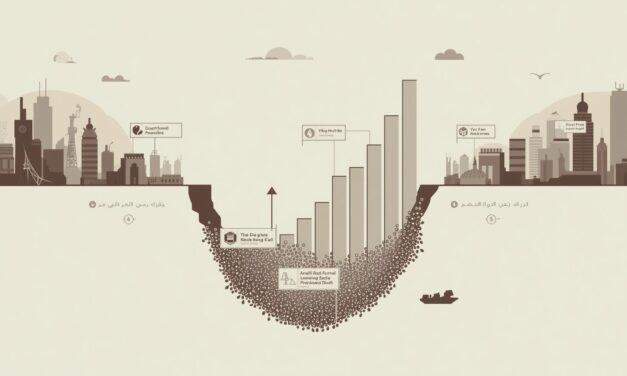
The Missing Middle: Why Oman’s Startups Stop Growing
Oman’s startup ecosystem is growing in number but not in depth. While micro-enterprises continue to expand rapidly, medium-sized firms remain largely stagnant. This analysis explains how tax thresholds, labor regulations, and financing gaps are creating a “missing middle” that prevents Omani businesses from scaling, and why fixing this structural issue is critical for Oman Vision 2040.
Read More
