Data Piece | Read time: 6 minutes
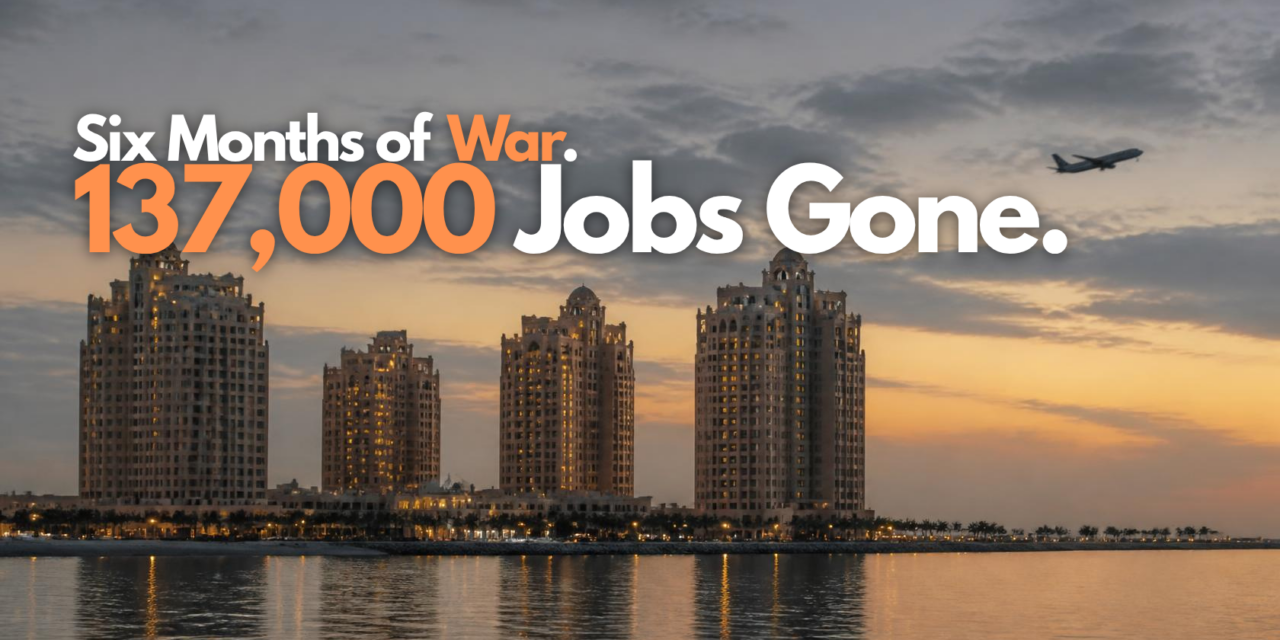
Six months after military conflict disrupted international travel corridors across the Arabian Peninsula, the tourism sector’s real war bill has come into full view: 137,000 jobs lost, and the count is still rising.
Travel and tourism employment across the six GCC member states contracted 4.3% against a 2025 baseline of 3.2 million workers, according to the World Travel & Tourism Council. Direct regional visitor spending losses reached $600 million daily during peak flight cancellations, as reported by Arabian Business.
The resumption of regional flights has failed to restore broader market stability. International leisure travelers and corporate delegations continue to cancel advance bookings, depressing occupancy levels despite restored seat capacity. This persistent shortfall travels downstream through supply chains, imperiling small and medium enterprises that service major hospitality operators.
Managing directors and commercial lenders face three critical operational realities. Employers concentrated payroll reductions in Saudi Arabia and the United Arab Emirates, where national diversification programs depend heavily on foreign visitor receipts.
Meanwhile, primary contractors protect liquidity by stretching supplier payment cycles, forcing logistics operators and trade financiers to pivot toward Asian commercial corridors.
Quantifying Regional Payroll Reductions
Member states experience the regional labor contraction unevenly. Saudi Arabia absorbed 69,000 lost or suspended positions, while employers in the United Arab Emirates cut approximately 46,000 roles.
Enterprises across Oman, Qatar, Bahrain, and Kuwait shed the remaining 22,000 positions, reversing momentum from 2025 when the UAE alone hosted 32.3 million hotel guests and generated AED 257 billion in tourism gross domestic product, according to HVS.
Hotel operators responded to plunging demand by shedding variable operating costs. Properties along Dubai’s Palm Jumeirah closed individual towers, citing maintenance to protect published rates. Managers targeted frontline personnel first, releasing housekeeping teams, banquet staff, and outsourced maintenance contractors under thirty-day dismissal notices.
Hospitality balance sheets sustained immediate top-line damage. The UAE hospitality sector absorbed daily visitor spending losses of $180 million during peak flight disruptions, while Saudi Arabia lost $120 million each day. International operators, including Marriott, Hilton, Hyatt, and Accor, registered double-digit revenue declines across their regional portfolios.
SME Liquidity and Working Capital Pressures
Hospitality payroll reductions triggered immediate cash-flow shocks across regional supply networks. In the UAE, the SME financing market represented $27.3 billion in outstanding funded facilities across 590,000 registered enterprises, according to Ken Research. Small and medium businesses generate 63.5% of non-oil gross domestic product, making supplier distress a systemic risk for commercial banking portfolios.
Corporate payment cycles deteriorated rapidly as hotel groups conserved cash. Standard GCC procurement agreements stipulate settlement within 30 to 60 days, yet receivable timelines for commercial laundries, maintenance contractors, and food purveyors expanded past 90 to 120 days.
While Saudi Arabia’s Government Tenders and Procurement Law mandates 90-day payments for state entities, private commercial subcontracts lack statutory settlement caps, as documented by GSDA Legal Consultants.
Sustained payment delays forced smaller vendors into debt restructuring. A commercial produce supplier in Dubai’s Al Quoz district saw average collection times expand from 38 days in January to 114 days by August. In Muscat, an industrial cleaning contractor serving regional resorts reported that 65% of customer balances exceeded 90 days past due.
If you run a mid-sized supplier in Dubai or Muscat, this payment delay changes your fourth-quarter operating calculations.
| Market | Baseline Indicator (2025) | Direct Job Losses (2026) | Peak Occupancy Contraction | Primary SME Liquidity Vulnerability | Strategic Defense Mechanism |
|---|---|---|---|---|---|
| United Arab Emirates | 32.3M hotel guests; AED 257B sector GDP | 46,000 roles | Dubai occupancy declined from 84.8% to 22.8%, per CoStar | Receivables stretching past 120 days for suppliers, per HAL ERP | AED 2.5B Dubai stimulus package; air-sea freight links, per TradeArabia |
| Saudi Arabia | 115.9M total visits; SAR 168B inbound spend | 69,000 roles | Moderate softening in Riyadh; stable holy sites | Unprotected private subcontracts facing frozen disbursements | Domestic tourism redistribution; state capital reallocation |
| Sultanate of Oman | 3.9M arrivals; RO 89.4M Salalah port revenue, per Salalah Port | Included in the regional balance of 137,000 | Salalah holiday occupancy dropped 88.4% | Working capital deficits among regional logistics suppliers, per Muscat Daily | Salalah-Jeddah overland transit; dry bulk exports to Asia |
Market Divergence Between GCC Hubs
The regional crisis revealed sharp differences in how member states structure hospitality demand. Destinations dependent on long-haul foreign leisure travelers recorded the steepest declines.
Dubai hotel occupancy fell from an 84.8% average in early 2026 to 22.8% during mid-March, according to lodging data compiled by CoStar. Across the UAE, hotel occupancy dropped 27.7 percentage points year-on-year through June, and revenue per available room fell 31.8%, as reported by MEED.
Domestic spending patterns shielded capital cities from severe occupancy losses. Abu Dhabi sustained a baseline occupancy of 39.5% during its lowest operational week by hosting diplomatic meetings and state delegations. Similarly, non-discretionary religious pilgrimage to Makkah and Madinah anchored Saudi Arabia’s baseline visitor numbers, offsetting corporate cancellations across Riyadh. Domestic volume buffers hotel room counts during regional crises. Yields on domestic bookings run lower than yields from international luxury demand.
Oman displayed divergent internal performance between its commercial and leisure centers. Muscat registered an occupancy spike of nearly 70% in late February when stranded transit passengers sought emergency lodging.
Conversely, the southern destination of Salalah saw holiday occupancy decline 88.4% to just 9% as charter operations halted and cross-country road trips dropped sharply.
Reorienting Freight Corridors Toward Asia
Gulf logistics authorities expanded cargo operations with Asian economies to counter lost Western passenger revenue. The core transit corridor linking Dubai, Doha, and Abu Dhabi normally carries 40 million passengers annually between Europe and Asia. With passenger traffic disrupted, regional carriers redeployed wide-body aircraft to freight routes into India and China.
dnata’s command centre at Dubai International and Dubai World Central now processes one million tonnes of annual air freight, according to Aviation Business Middle East. flydubai assigned dedicated Boeing 737-800 freighters there for routes into Central and South Asia, per Travel PR News.
Oman opened an overland corridor to bypass Red Sea disruptions. Container traffic at the Port of Salalah fell 16% in early 2024, and general cargo volumes rose 4% to 11.655 million tonnes on gypsum and limestone shipments to India, according to Muscat Daily. The new trucking route to Jeddah takes four to five days, cutting transit times by 20% to 40% compared with maritime bypass routes, as reported by the Oman Observer.
The Reserve Bank of India and the Central Bank of the UAE signed a Local Currency Settlement System, according to the Reserve Bank of India. Commercial importers now settle more than 15% of bilateral trade directly in dirhams and rupees, according to Kotak Neo. Local currency billing reduces foreign exchange risk for cross-border traders. Consumer spending deficits from the tourism downturn remain a separate factor in the region’s recovery.
The regional shock prompts a decisive strategic reallocation of sovereign capital across the Gulf. Finance ministries in Riyadh, Abu Dhabi, and Muscat are channeling commercial capital into industrial freight corridors, advanced manufacturing, and Asian trade links rather than standalone luxury resorts.
Tourism operators restructuring services around regional corporate travel and Asian corridors are positioned to maintain operational stability through 2027. Hospitality businesses maintaining elevated cost structures amid depressed Western leisure volumes face heightened insolvency risk over the coming twelve months.