Feature | Read time: 12 minutes
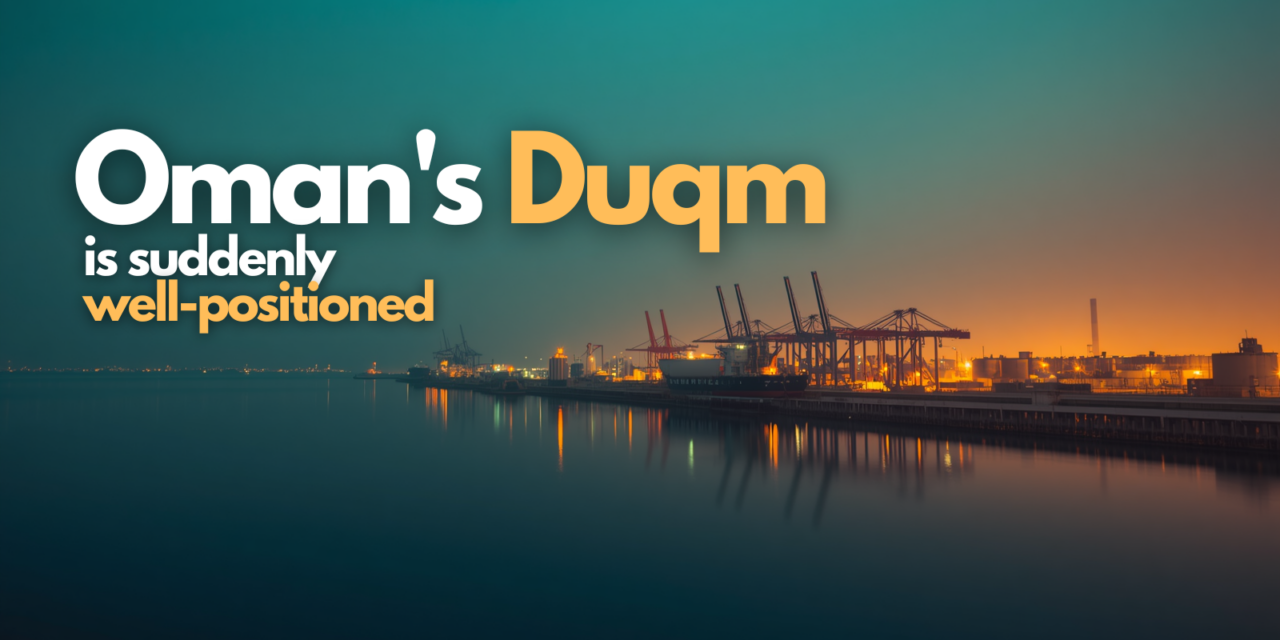
The Port of Duqm has emerged as a vital hub as the maritime trade network of West Asia experienced a fundamental reorganization in early 2026.
The closure of the Strait of Hormuz in February 2026 caused the largest disruption to seaborne trade in modern history, forcing shipping lines to activate alternative routes [1]. Sitting entirely outside this volatile waterway, the port provides direct access to the Indian Ocean, South Asia, and East Africa [2]. Years of deliberate public investment in port infrastructure, downstream energy assets, and overland road and rail connections are translating into active trade flows [4].
Reggy Vermeulen, Chief Executive Officer of the Port of Duqm Company, has observed that this shift represents a direct endorsement of the port’s long-term planning [6]. He stated that this investment demonstrates international partner trust in the Port of Duqm’s trajectory and Oman’s broader economic goals[6]. Rather than serving as a short-term crisis bypass, Duqm is establishing its position as a central component of regional trade diversification [7].
A pronounced pivot toward Asian markets and the strategic repositioning of sovereign wealth capital across the GCC drive this development [4].
Strait Instability Accelerates Gulf Bypass Corridors
The current instability in maritime chokepoints has accelerated regional efforts to establish land and sea corridors that operate independently of the Persian Gulf [10]. Terminal operators and sovereign entities are investing in infrastructure designed to secure logistics routes during prolonged disruptions [4].
For example, DP World is expanding port and freight-handling capacity on the East Coast of the United Arab Emirates to access the Gulf of Oman directly [4]. These plans include constructing a second crude oil pipeline to parallel the Habshan-Abu Dhabi line, which will double the transport capacity to 3 million barrels per day [4].
Oman’s geographic positioning outside the Persian Gulf allows its deep-water ports at Sohar, Duqm, and Salalah to absorb redirected trade volumes [2]. This capability did not emerge suddenly but represents decades of targeted spending on transport networks and special economic zones [5]. During the recent shipping crisis, Omani port authorities successfully managed the transit of hundreds of additional vessels [5]. Quantitative trade shifts demonstrate the economic value of this infrastructure [5].
Customs declarations within the green corridor established between Dubai and Oman in March 2026 escalated from 1 billion UAE Dirhams to more than 8 billion UAE Dirhams[5]. This shift moved a massive volume of cargo to Omani sea and air terminals [5].
Simultaneously, the Emirate of Sharjah launched its own logistics corridor, linking Omani ports to northern border crossings to protect supply chain continuity [5]. These developments highlight the emergence of a highly integrated regional transit network [5].
| Logistics Corridor | Infrastructure Components | Financial Sizing and Metrics | Strategic Trade Outcome | |
|---|---|---|---|---|
| Dubai-Oman Green Corridor | Omani ports and airports linked to UAE land borders | Customs declarations grew from AED 1B to over AED 8B in March 2026 | Successful diversion of blocked Persian Gulf shipping | |
| Parallel Habshan-Abu Dhabi Pipeline | Duplicated crude pipeline to Fujairah terminals | Sized to double export capacity from 1.5M to 3M bpd | Bypasses the Strait of Hormuz for UAE crude exports | |
| Sharjah-Oman Transit Route | Land border crossings to Omani deepwater ports | Multimodal cargo trucking and customs clearing | Protects supply chain continuity for UAE manufacturing |
Sources: [4], [5]
Oman-India Trade Deal Secures Energy Lanes
The entry into force of the India-Oman Comprehensive Economic Partnership Agreement on June 1, 2026, accelerates Oman’s Asia pivot [9]. While Oman represents a modest domestic market of 5.5 million people, its strategic value to India lies in its role as a gateway connecting South Asia to wider GCC and African markets [9]. The bilateral agreement establishes a highly liberalized trade framework that removes historical tariff asymmetries [12]. Under the agreement, Oman offers immediate zero-duty access on 98.08 percent of its tariff lines, covering 99.38 percent of Indian exports by value [9].
India has reciprocated by reducing or eliminating tariffs on 77.79 percent of its tariff lines, representing 94.81 percent of Omani imports by value [14]. India protects sensitive domestic sectors like dairy, cereals, and agriculture through strict exclusion lists [15]. The agreement supports the industrial competitiveness of Omani exports by simplifying trade in downstream chemicals, metals, plastics, and fertilizers [13]. For Indian exporters, the agreement removes the historical 5 percent duty on machinery, iron, steel, and textiles [13].
In the pharmaceutical sector, the agreement introduces regulatory fast-tracking, allowing generic medicines approved by major regulators to receive Omani marketing authorizations within 90 days [8]. Energy security requirements further reinforce the strategic relevance of this export corridor [9].
During the maritime blockades of early 2026, India shifted its LNG sourcing from Persian Gulf ports to Omani terminals [3]. Oman emerged as India’s largest LNG supplier during this period, accounting for 30 to 31 percent of total Indian LNG imports [3].
To build a permanent bypass, both nations are advancing the Middle East-India Deepwater Pipeline across the Arabian Sea [9]. This 4.8 billion US dollar subsea project will span 2,000 kilometers, connecting gas fields in Oman directly to the Indian state of Gujarat [9]. Furthermore, the agreement improves professional mobility to support the operation of over 6,000 active joint ventures [9].
The agreement raises the ceiling for intra-company transferees to 50 percent and establishes binding commitments for defined professional categories [9].
| CEPA Provision | Impact on Indian Exporters | Impact on Omani Exporters | Strategic Integration Outcome | |
|---|---|---|---|---|
| Tariff Elimination | Zero-duty access on 98.08% of Omani tariff lines | Zero-duty access on 77.79% of Indian tariff lines | Immediate price competitiveness for manufacturing sectors | |
| Professional Mobility | ICT ceiling increased from 20% to 50% | Eased entry and stay conditions for healthcare and IT | Enforceable paths for technical and managerial talent | |
| Trade Facilitation | EIC inspection and Halal certificates accepted directly | Simplified rules of origin under CAROTAR 2020 | Reduced transaction costs and faster customs clearance | |
| Energy Securement | Stable export channels for petroleum and fertilizers | Direct supply agreements for Omani LNG | Oman became India’s largest LNG supplier in early 2026 |
Sources: [3], [9], [16]
Sovereign Wealth Funds Anchor Localized Manufacturing
Sovereign wealth fund investments actively support the expansion of Duqm as a global industrial hub [20]. The Oman Investment Authority managed state assets worth 23 billion Omani Rials, equivalent to approximately 60 billion US dollars, in 2025 [22].
The authority divides its portfolio between the Future Generations Fund for international assets and the National Development Fund to support domestic economic diversification [23]. To attract foreign direct investment, the authority launched the Future Fund Oman in 2024 with a capital of 5.2 billion US dollars [24].
Future Fund Oman has committed 585 million US dollars alongside 458 million US dollars in local private investment to fund 105 strategic projects [25]. This sovereign capital supports industrial localization, including the Orion Solar cell facility in the Sohar Freezone [25]. It also funds the Gallant Industrial Project, which produces 66,000 tonnes of lithium iron phosphate cathode materials annually [25]. These initiatives align Omani domestic investment with broader GCC sovereign strategies [4].
The Saudi Public Investment Fund has signed a memorandum of understanding with the Oman Investment Authority to coordinate cross-border investments [26]. This partnership operates alongside the Saudi Omani Investment Company, which intends to invest up to 5 billion US dollars in Oman’s industrial sectors [26].
Karwa Motors, a strategic joint venture between Mowasalat Qatar and the Oman Investment Authority, represents a key example of regional joint investment [27]. Located on a 220,000 square meter site within the Special Economic Zone at Duqm, Karwa Motors represents the Sultanate’s first bus assembly plant [27].
The facility employs modern welding, paint, and assembly shops, using technology transfer agreements to manufacture commercial buses [27]. The factory commenced commercial operations by producing 500 buses for the 2022 FIFA World Cup and now targets up to 700 buses annually [27].
Dr. Ibrahim Albalushi, Chief Executive Officer of Karwa Motors, stated that placing the manufacturing facility at the Port of Duqm provides direct access to international shipping lines [28]. He noted that this vehicle manufacturing plant creates valuable opportunities for new small enterprises while offering Omani youth a direct path into the automotive industry [30].
OQ Infrastructure Establishes Clean Downstream Cluster
OQ, Oman’s state-owned integrated energy company, forms the industrial foundation of the Duqm zone[31]. Led by Group Chief Executive Officer Ashraf Hamed Al Mamari, OQ has executed a 10 billion US dollars investment program to develop a downstream energy cluster outside the Strait of Hormuz [31]. The primary asset in this cluster is the Duqm Refinery, known as OQ8, a joint venture between OQ and Kuwait Petroleum International [31]. With a processing capacity of 255,000 barrels of crude oil per day, OQ8 has exported over 560 product shipments since achieving commercial operations [31].
To support the refinery, OQ operates the Ras Markaz Crude Oil Storage Terminal through its subsidiary, the Oman Tank Terminal Company [31]. An 80-kilometer pipeline directly links the terminal to the Duqm Refinery, handling over 176 million barrels of crude oil [31]. Marafiq, an OQ subsidiary, provides the utility infrastructure for this downstream complex by operating a 326 MW power plant and a water desalination plant [31]. Marafiq has achieved 100 percent operational readiness, delivering over 85 GWh of electricity and 710,000 cubic meters of water [31].
Oman’s long-term energy strategy uses this industrial base to transition toward clean-fuel production [36]. The Public Authority for Special Economic Zones and Free Zones signed ten investment agreements worth 2.9 billion Omani Rials in June 2026 to expand industrial output [39]. This includes the downstream component of the ACME green hydrogen and ammonia project, representing a 4.2 billion US dollars investment [39]. ACME Group will develop phases two and three to produce 800,000 tonnes of green ammonia and 142,000 tonnes of green hydrogen annually [39].
The HYPORT Duqm project similarly uses the zone’s solar and wind resources to split water into hydrogen and oxygen, converting the output into green ammonia for export [37]. Foreign direct investment funds this transition through significant port capacity expansions [6]. Investcorp Aberdeen Infrastructure Partners has signed a cooperation agreement to invest in a 550 million US dollar infrastructure project at the Port of Duqm [6]. The expansion involves extensive dredging and the construction of a new quay wall to service a low-carbon green steel industrial plant [6].
| Downstream & Green Energy Project | Location / Footprint | Financial Investment | Targeted Output & Capacity | |
|---|---|---|---|---|
| Duqm Refinery (OQ8) | SEZAD Petrochemical Zone | Over $9 Billion | 255,000 barrels of refined products per day | |
| Ras Markaz Terminal (OTTCO) | Ras Markaz Coastline | Integrated in OQ Portfolio | 26.7 million barrels total storage capacity | |
| ACME Green Hydrogen | 10 square kilometer site | $4.2 Billion | 800,000 tonnes of green ammonia per year | |
| Port of Duqm AIIP Project | Main Duqm Port Basin | $550 Million | Construction of a new quay wall and dredging | |
| Marafiq Utility Complex | Special Economic Zone | OQ Utility Investment | 326 MW power plant and 36,000 m³/day water |
Sources: [6], [31], [39]
Overland Transportation Networks Speed Transit Times
GCC states are developing direct cross-border road and rail links to reduce shipping transit times [10]. The first cross-border railway project, Hafeet Rail, is a 2.5 billion US dollar joint venture between Etihad Rail, Oman Rail, and Mubadala Investment [42]. Spanning 238 kilometers, the railway connects the UAE national rail network at Al Ain directly to Sohar Port in Oman [42]. As of April 2026, civil works and major structures are 40 percent complete across key locations [42].
Eng. Abdulrahman Al Hatmi, Group CEO of Asyad Group, emphasized that this railway connection creates a fully integrated intermodal logistics network [43]. Asyad’s global expansion supports this intermodal capacity, which includes acquiring dry port assets in Uzbekistan to connect Central Asian exports directly to Omani ports [45]. Overland road infrastructure further supports this rail system, specifically the direct highway linking Saudi Arabia and Oman across the Rub’ Al Khali desert [2]. Pushing a dual highway through the shifting sands of the Empty Quarter required 1.3 million work hours and 750 pieces of heavy machinery [46].
The opening of the Ramlet Khelah border crossing has cut traveling times by 16 hours, driving a sharp increase in trade volumes [47]. The value of goods crossing the border rose from 300 million US dollars in February 2026 to 830 million US dollars in March 2026 [47]. The primary cargo consists of fertilizers, construction materials, agricultural inputs, and medicines[47]. To support this trade volume, the two nations are developing the Special Economic Zone at Al Dhahirah [2].
| GCC Railway & Highway Parameter | Technical Specification / Metric Value | Logistics Significance | |
|---|---|---|---|
| Hafeet Rail Total Distance | 238 kilometers | Connects Omani ports to 15+ integrated hubs | |
| Rail Freight Transport Capacity | 15,000 tons / 276 TEU per trip | Low-carbon alternative to road container transport | |
| UAE-Oman Transit Time | 100 minutes (passenger services) | Integrates industrial zones of both nations | |
| Empty Quarter Highway | 725 kilometers total length | Connects Riyadh directly to Ibri in Oman | |
| Batha Haradh Section (KSA) | 564 kilometers across desert | Overcomes shifting dunes with modern engineering |
Sources: [2], [42], [43], [46]
FDI Diversifies Beyond Original Chinese Investments
The Sino-Oman Industrial Park anchored the early phase of foreign investment in Duqm under a 50-year lease signed in May 2016 [49]. Master-developed by Oman Wanfang, the 12.72 square kilometer development has a planned overall investment of 10.7 billion US dollars [49]. Initial developments focused on petrochemicals, methanol production, building materials, and vehicle assembly [52]. However, the investment dynamics in Duqm have diversified significantly [54].
Chinese foreign direct investment declined relative to earlier projections during the later stages of Duqm’s development [54]. The strategic focus of the Special Economic Zone has shifted from heavy carbon-intensive refining toward clean energy, hydrogen derivatives, and digital infrastructure [54].
This shift has attracted significant capital from British, European, and Korean investors through Hydrom [37]. Despite this shift, Chinese industrial firms continue to implement targeted manufacturing projects, such as a 500 million US dollar silicon-based anode material facility signed in June 2026 [29].
Industrial Diversification Reshapes Indian Ocean Trade
The Port of Duqm’s maturation marks a fundamental shift in how the GCC secures its external trade [4]. By establishing deep-water access entirely outside the Strait of Hormuz, Oman has built an alternative trade route that continues to move cargo when maritime blockades close the Persian Gulf [2].
The structural integration of the India-Oman CEPA, cross-border rail connections, and low-carbon industrial clusters will permanently alter cargo routing patterns across the Indian Ocean[6]. Future expansion will likely focus on linking Duqm’s green hydrogen infrastructure directly to European and Asian industrial supply chains [37].
1. A network of corridors is the only reliable hedge against Middle East chokepoint disruptions, https://www.atlanticcouncil.org/in-depth-research-reports/report/a-network-of-corridors-is-the-only-reliable-hedge-against-middle-east-chokepoint-disruptions/
2. Why Saudi Investors Are Forming Companies in Oman: The 2026 Guide, https://aowjbusinessconsultant.com/why-saudi-investors-are-forming-companies-in-oman-the-2026-guide
3. Oman–India Corridor: Can Muscat Offer New Pathways Beyond the Strait of Hormuz?, https://oneworldoutlook.com/opinion/oman-india-corridor-can-muscat-offer-new-pathways-beyond-the-strait-of-hormuz/
4. DP World Is Building a New Port to Bypass the Strait of Hormuz. The UAE Is Not Waiting for the War to End. – Centrum-AI, https://www.centrum-ai.com/newsroom/supply-chain-alerts/dp-world-is-building-a-new-port-to-bypass-the-strait-of-hormuz-the-uae-is-not-waiting-for-the-war-to-end
5. We need more diversified hubs for global trade resilience – The World Economic Forum, https://www.weforum.org/stories/trade-and-investment/fragmented-world-diversified-global-trade-hubs/
6. Investcorp to Invest in Port of Duqm expansion, https://www.investcorp.com/investcorp-to-invest-in-port-of-duqm-expansion/
7. Reviving India-Oman Relations: Strategic Cooperation and Economic Integration, https://studies.aljazeera.net/en/analyses/reviving-india-oman-relations-strategic-cooperation-and-economic-integration
8. PR INTEGRATED (India) highlights India–Oman CEPA Driving Trade Growth and Expanding Market Access – Panco Group, https://www.pancoworld.com/member-news/pr-integrated-india-highlights-india-oman-cepa-driving-trade-growth-and-expanding-market-access
9. India and Oman energize a new Trade Gateway through a landmark Comprehensive Economic Partnership Agreement (CEPA) – PIB, https://www.pib.gov.in/PressReleasePage.aspx?PRID=2267513
10. New Middle East corridors are about more than just bypassing the Strait of Hormuz, https://www.atlanticcouncil.org/blogs/menasource/new-middle-east-corridors-are-about-more-than-just-bypassing-the-strait-of-hormuz/
11. UAE Plans to Build a New Jebel Ali to Bypass Strait of Hormuz – The Maritime Executive, https://maritime-executive.com/article/uae-plans-to-build-a-new-jebel-ali-to-bypass-strait-of-hormuz
12. India–Oman CEPA: A Strategic Gateway in a Shifting West Asian Order – NIICE NEPAL, https://niice.org.np/archives/12214
13. India–Oman CEPA – PIB, https://www.pib.gov.in/PressReleasePage.aspx?PRID=2213203
14. India-Oman CEPA Enters into Force: What the Agreement Means for Omani Businesses, https://www.middleeastbriefing.com/news/india-oman-cepa-enters-into-force-businesses/
15. India-oman cepa: key provisions, trade benefits & strategic significance – IAS Gyan, https://www.iasgyan.in/daily-editorials/india-oman-cepa-key-provisions-trade-benefits-strategic-significance
16. India–Oman Comprehensive Economic Partnership Agreement (CEPA) Comes into Force on 1 June 2026 – PIB, https://www.pib.gov.in/PressReleasePage.aspx?PRID=2268595
17. India secures critical trade and energy channels through Oman partnership as Hormuz disruptions loom – ET Chemical News, https://chemicals.economictimes.indiatimes.com/news/petrochemicals/india-secures-critical-trade-and-energy-channels-through-oman-partnership-as-hormuz-disruptions-loom/131528269
18. India and Oman energize a new Trade Gateway through a landmark Comprehensive Economic Partnership Agreement (CEPA) – PIB, https://www.pib.gov.in/PressReleasePage.aspx?PRID=2267513
19. The Oman-India Comprehensive Economic Partnership Agreement (“CEPA”) will enter into force soon – PwC, https://www.pwc.com/m1/en/services/tax/middle-east-tax-news-alerts/2026/oman-first-comprehensive-economic-partnership-agreement.html
20. Duqm – Magazine – 43nd Issue – April 2026, https://www.opaz.gov.om/upload/files/Duqm_Magazine_April2026_Issue43_En.pdf
21. Duqm: A global investment destination in industry, tourism and renewable energy, https://www.fm.gov.om/en/31030/
22. Oman Investment Authority, https://oia.gov.om/en
23. Oman Investment Authority – IFSWF, https://www.ifswf.org/member-profiles/state-general-reserve-fund
24. Oman – Launched $5.2 billion Future Fund for FDI and SMEs | Investment Policy Monitor, https://investmentpolicy.unctad.org/investment-policy-monitor/measures/4536/oman-launched-5-2-billion-future-fund-for-fdi-and-smes
25. Oman’s future fund unveils $1.74bn development projects, https://www.tradearabia.com/News/465218/Oman%E2%80%99s-future-fund-unveils-%241.74bn-development-projects
26. PIF and Oman Investment Authority Sign a Memorandum of Understanding To Expand Investment in the Sultanate of Oman, https://www.pif.gov.sa/en/news-and-insights/press-releases/2023/pif-and-oman-investment/
27. Where is Karwa Motors Located? HQ, Global Offices & Company Insights – Highperformr, https://www.highperformr.ai/company/karwamotors
28. Made with Pride in the Sultanate of Oman – Karwa Motors, https://karwamotors.com/about-us.php
29. Karwa commences operations and rolls out the first bus from its factory in duqm, https://karwamotors.com/news-details-2.php
30. Message from our chairman – Karwa Motors, https://karwamotors.com/chairmans-message.php
31. OQ Enables Duqm’s Growth Journey through $10+Billion Strategic Investment Shaping the Future of Industry and Energy in Oman, https://oq.com/en/news-and-media/newsroom/20251024-oq-enables-duqms-growth-journey-through-10-billion-strategic-investment
32. OQ (company) – Wikipedia, https://en.wikipedia.org/wiki/OQ_(company)
33. Ashraf Al Mamari: profile – The Arab Leader, https://thearableader.com/ashraf-al-mamari-transformative-leader-shaping-the-future-of-omans-energy-sector/
34. OQ and KPI sign development agreement for petrochemicals project in Oman, https://theenergyyear.com/news/oq-and-kpi-sign-development-agreement-for-petrochemicals-project-in-oman/
35. Our Growth Projects | OQ, https://oq.com/en/our-business/growth-projects
36. CEO Message – Port of Duqm, https://portofduqm.om/logistics-solutions-in-oman/ceo-message/
37. Green Hydrogen Projects in Duqm: Investment and SME Opportunities – Finsoul Network, https://finsoulnetwork.com/om/blog/green-hydrogen-projects-in-duqm/
38. How Oman’s energy sector is transitioning to clean fuels – Oxford Business Group, https://oxfordbusinessgroup.com/reports/oman/2023-report/energy/in-transition-oil-and-gas-are-still-the-central-to-the-industry-but-efforts-are-under-way-to-facilitate-the-switch-to-cleaner-fuels-overview/
39. 10 agreements signed for new projects in Duqm worth nearly OMR 3 billion, https://www.fm.gov.om/en/47729/
40. Second phase of ACME’s Duqm hydrogen project to start operations in 2030 – Muscat Daily, https://www.muscatdaily.com/2026/06/10/second-phase-of-acmes-duqm-hydrogen-project-to-start-operations-in-2030/
41. Green hydrogen: Ras Duqm, https://www.rgs.org/media/2dnnozri/green-hydrogen_lesson-plan.pdf
42. UAE, Oman Press On With Rail Link Project – MEP Middle East, https://www.mepmiddleeast.com/news/uae-oman-press-on-with-rail-link-project
43. Hafeet Rail Announces 40% Completion of the Oman–UAE Railway Connection Project – Asyad Group, https://www.asyad.om/your-logistics-hub-in-mena/2026/04/21/hafeet-rail-announces-40-completion-of-the-oman-uae-railway-connection-project
44. UAE-Oman Hafeet Rail project signs $1.5 billion bank financing deals, https://economymiddleeast.com/news/uae-oman-hafeet-rail-project-signs-1-5-billion-bank-financing-deals/
45. Asyad Group Expands Its Global Footprint with the Acquisition of a Controlling Stake in Uzbekistan’s Logistics Platforms, https://kommunikasjon.ntb.no/pressemelding/18935313/asyad-group-expands-its-global-footprint-with-the-acquisition-of-a-controlling-stake-in-uzbekistans-logistics-platforms-advancing-trade-corridors-and-regional-connectivity-across-central-asia?publisherId=4954260&lang=en
46. Saudi-Oman Highway: Engineering Marvel in Empty Quarter, Boosting Trade, Tourism, https://www.spa.gov.sa/en/N2147240
47. Complete Guide: Saudi Arabia to Oman Border Crossing (March 2026 Update), https://www.lnkoman.com/complete-guide-saudi-arabia-to-oman-border-crossing-march-2026-update/
48. BRI-Backed Oman Economic Zone Attracts Raft of Global Investors, https://beltandroad.hktdc.com/en/insights/bri-backed-oman-economic-zone-attracts-raft-global-investors
49. As US ties fray, top Oman official visits China: What to know – AL-MONITOR, https://www.al-monitor.com/originals/2026/07/us-ties-fray-top-oman-official-visits-china-what-know
50. Part 3 of 4 – China’s Approach to Iraq, Egypt, and Oman – New Lines Institute, https://newlinesinstitute.org/wp-content/uploads/FINAL-12192025-China-Impact-ME__.pdf
51. Spotlight: China, Oman establish industrial park to boost bilateral cooperation – Xinhua, http://www.xinhuanet.com/english/2018-12/19/c_137683272.htm
52. China’s Wanfang to establish building materials market in Oman’s special economic zone, http://global.chinadaily.com.cn/a/201806/05/WS5b163393a31001b82571e454.html
53. The Special Economic Zone at Duqm, Oman (Case Study 3.3) – A Casebook on Chinese Outbound Investment – Cambridge University Press & Assessment, https://www.cambridge.org/core/books/casebook-on-chinese-outbound-investment/special-economic-zone-at-duqm-oman/D5F3AA92E1A75CAE718D077722C202F4