Why Logistics Will Decide the GCC’s EV Manufacturing Future
As Saudi Arabia, the United Arab Emirates, and Oman accelerate investment into electric vehicle manufacturing, a structural constraint is beginning to shape the sector’s long-term viability. The challenge is not consumer demand, incentives, or factory construction. It is logistics.
Specifically, how to move heavy battery packs, vehicle subassemblies, and industrial inputs across borders at scale without eroding the economic and environmental rationale for electric mobility.
Electric vehicle supply chains place far greater strain on transport systems than traditional automotive manufacturing. Battery packs weigh between 500 and 900 kilograms, require careful handling, and move in large volumes between processing sites, assembly plants, and ports. Relying on road freight for this flow increases emissions, raises costs, and introduces congestion risk.
As production volumes rise, logistics shifts from a support function to a decisive factor in regional competitiveness.
Hafeet Rail directly addresses this constraint. By linking Oman’s industrial ports with the UAE’s manufacturing zones through a high-capacity, low-emission rail corridor, the project reshapes how EV supply chains can be designed across the GCC. It is not a transport upgrade. It is an industrial enabler.
Hafeet Rail as a Supply Chain Enabler
Hafeet Rail is a 238-kilometer cross-border railway developed as a joint venture between Etihad Rail, Oman Rail, and Mubadala Investment Company. The line connects Sohar Port and Freezone in Oman to the UAE’s national rail network at Al Ain, integrating two of the region’s most important industrial corridors.
What matters strategically is not the route itself, but its specifications. Freight trains are designed to carry over 15,000 tonnes per journey, operate at speeds of up to 120 kilometers per hour, and support axle loads of up to 32.4 tonnes. These parameters are critical for EV manufacturing, where components are dense, heavy, and moved in bulk.
By providing predictable, high-capacity cross-border transport, rail changes the economics of production. Manufacturers can plan larger batch movements, reduce buffer inventories, and design facilities based on regional optimization rather than national constraints.
Solving the Heavy Battery Transport Problem
Battery logistics is the defining challenge of EV manufacturing. A single electric vehicle battery pack can weigh as much as a small car engine, and large-scale production requires moving thousands of these units between processing, assembly, and export points.
Transporting batteries by road demands a high number of truck movements, increasing emissions and road congestion while raising insurance and handling risks. Hafeet Rail offers a structural alternative. Each fully loaded freight train can remove approximately 300 trucks from regional highways, cutting transport-related carbon emissions by up to 80 percent compared to road freight.
This reduction is not incremental. It allows EV supply chains to scale without undermining national decarbonization commitments, including the UAE’s Net Zero 2050 target and Oman’s Vision 2040 framework. Rail becomes a prerequisite for sustainable scale, not just a greener option.
From Isolated Industrial Zones to an Integrated Manufacturing System
The strategic value of Hafeet Rail is amplified by the industrial ecosystems at each end of the corridor.
At Sohar Port and Freezone, Oman is building an integrated EV and battery value chain, covering raw material processing, battery cell production, and component manufacturing. The planned start of operations at JA Solar’s manufacturing complex in 2026 adds a renewable energy dimension that supports the broader EV ecosystem.
On the UAE side, Khalifa Economic Zones Abu Dhabi has positioned itself as a regional automotive hub, hosting vehicle distributors, assemblers, and component suppliers. Access to heavy raw materials such as aluminum and polymers strengthens its manufacturing base.
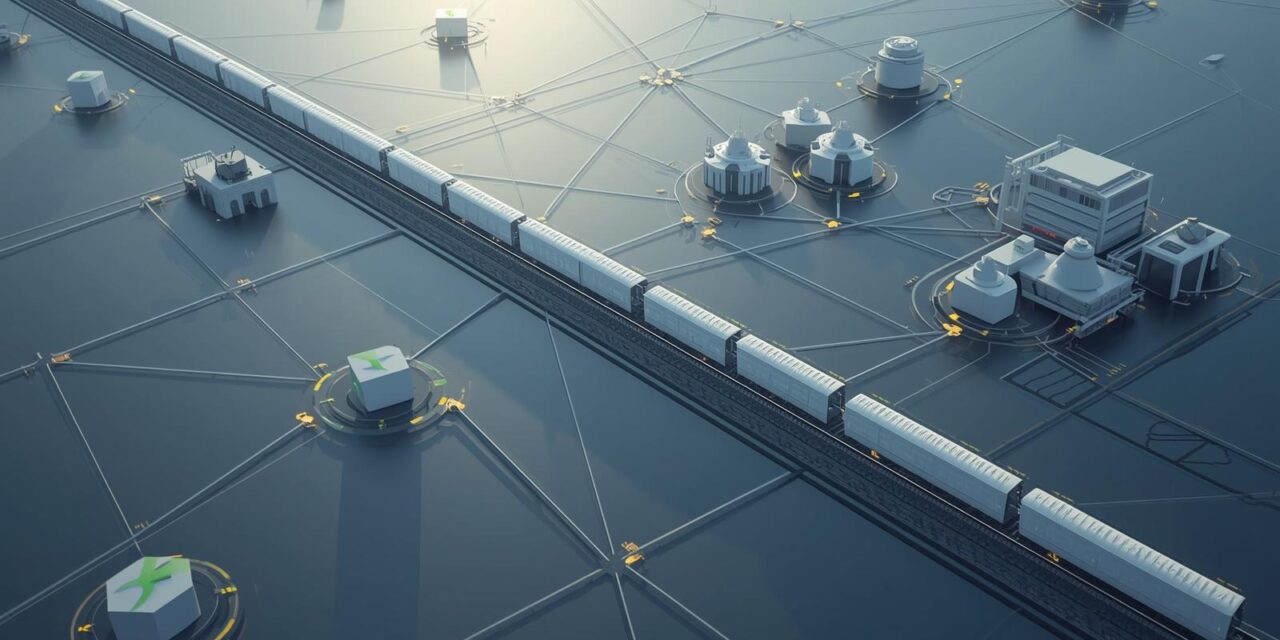
Hafeet Rail connects these clusters into a single production system. Instead of operating as standalone zones competing for investment, Sohar and Abu Dhabi become interdependent nodes in a regional value chain. This integration improves resilience, reduces duplication, and increases the region’s appeal to global manufacturers seeking scale and certainty.
Multimodal Integration as a Strategic Advantage
Beyond rail and sea connectivity, Hafeet Rail introduces a multimodal dimension through its integration with Al Ain International Airport. An agreement between Abu Dhabi Airports and Hafeet Rail supports direct air-rail transfers for time-sensitive and high-value components.
As electric vehicles become more electronics-intensive, the ability to move specialized components quickly becomes a competitive advantage. Air-rail integration allows critical parts to be flown into the region and distributed efficiently by rail, bypassing congested road routes and border delays.
This capability supports both manufacturing continuity and aftermarket service operations.
What This Means for Investors, OEMs, and Policymakers
For original equipment manufacturers, rail-backed logistics reduces operational risk and enables higher levels of localization. Battery plants, assembly facilities, and suppliers can be placed where they make the most economic sense, not where road transport limits allow.
For investors, infrastructure-linked industrial clusters lower execution risk and improve long-term asset viability. Logistics certainty supports higher utilization rates and more stable returns.
For policymakers, Hafeet Rail demonstrates how transport infrastructure functions as industrial policy. Cross-border corridors do not merely move goods. They shape where value is created and how competitive entire sectors become.
Redefining Regional EV Logistics
With construction estimated to be between 50 and 70 percent complete as of late 2025 and testing expected to begin in early 2026, Hafeet Rail is moving from concept to operational reality. Its significance lies not in kilometers of track, but in the system it enables.
By linking ports, factories, and logistics hubs across Oman and the UAE, the project provides the foundation for a regional EV manufacturing platform.
In doing so, Hafeet Rail shifts the GCC from localized production experiments toward an integrated, scalable, and export-ready electric vehicle supply chain.