Treating the Sky as Infrastructure
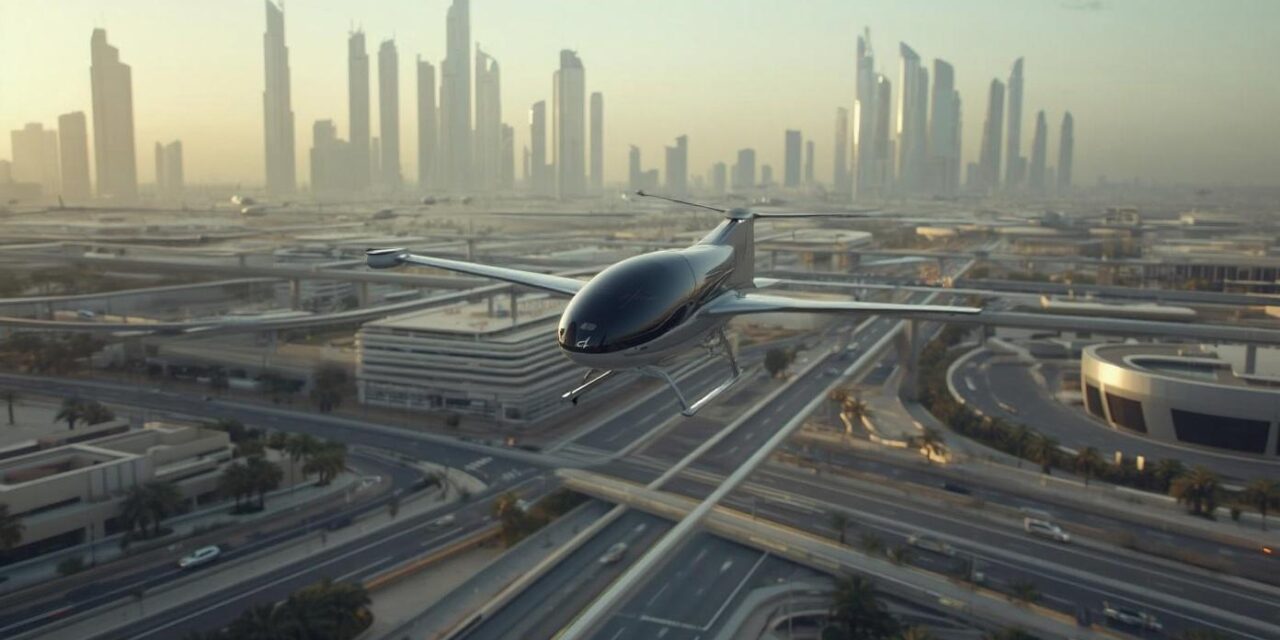
In March 2026, Dubai will begin operating its airspace as a functional layer of public transport. The launch of commercial flying taxi services is not positioned as a technology showcase, but as a response to a familiar urban constraint, congestion in a fast-growing, high-velocity city. Instead of expanding road capacity, Dubai is introducing a vertical mobility layer that bypasses it entirely.
While many global cities continue to test advanced air mobility through pilots and demonstrations, Dubai is moving directly into commercial operation. Aircraft selection, regulatory alignment, and physical infrastructure have progressed in parallel. This coordinated approach explains why the city is prepared to move from concept to daily use within a defined timeline.
From Experiment to Executable Network
Urban air mobility initiatives often fail when treated as isolated experiences rather than networks. Dubai’s approach avoids this pitfall by anchoring the service around four strategically placed vertiports that reflect how people already move through the city.
The first hub at Dubai International Airport is designed as a multi-level facility directly linked to the Emirates Metro Station. This integration allows passengers to transition from rail to air without entering road traffic. With capacity to handle up to 170,000 passengers annually, the airport vertiport is positioned as a functional extension of the existing transport system.
The remaining hubs reinforce this network logic. Palm Jumeirah serves one of the city’s highest-density tourism corridors near Atlantis The Royal. Downtown Dubai connects the retail and commercial core surrounding Dubai Mall. Dubai Marina, located at the American University in Dubai, links a major residential and office district in the south. Together, these sites form a deliberate grid connecting tourism, commerce, and residential zones.
Time Certainty as the Core Value
Speed is an obvious benefit of aerial travel, but predictability is the more important outcome. At peak hours, a car journey from the airport to Dubai Marina can exceed 45 minutes, with arrival times heavily influenced by traffic conditions. The flying taxi route reduces that journey to approximately 15 to 18 minutes, independent of road congestion.
Similar gains apply across the network. Flights from the airport to Palm Jumeirah are expected to take between 10 and 12 minutes. For business travelers and residents managing tight schedules, this converts time from a variable cost into a fixed one. In a city where productivity is closely tied to movement, that reliability carries measurable economic value.
Choosing the Right Aircraft for Urban Reality
The aircraft underpinning this service is the Joby S4, an electric vertical take-off and landing craft designed for short, repeated urban flights. It accommodates one pilot and four passengers, with a maximum speed of 320 kilometres per hour and a range of up to 160 kilometres on a single charge.
Equally important is what the aircraft does not produce. Electric propulsion eliminates exhaust emissions and significantly reduces noise levels, a critical requirement for operating over dense residential and commercial districts. These characteristics make sustained urban operations viable, rather than disruptive.
The choice of aircraft reflects a focus on operational practicality rather than experimental capability. The specifications align with the city’s route distances, passenger demand, and environmental priorities.
Economic and Workforce Implications
The introduction of flying taxis aligns directly with the Dubai Economic Agenda D33, which emphasizes infrastructure as a catalyst for long-term economic competitiveness. Beyond passenger transport, the system creates demand for skilled roles in aviation operations, maintenance, air traffic coordination, and pilot training.
More broadly, the initiative supports the development of a local air mobility ecosystem. This includes regulatory frameworks, safety standards, and operational expertise that can be applied to future aviation technologies. The value lies not only in the service itself, but in the institutional capability built around it.
A Signal of How Dubai Plans to Grow
Dubai’s decision to invest in vertical mobility reflects a broader urban strategy. Rather than expanding outward through additional road networks, the city is exploring how space can be used more efficiently by adding layers. This approach acknowledges physical limits while preserving economic momentum.
For other global cities, the March 2026 launch serves as a reference point. It demonstrates how emerging transport technologies can be integrated into everyday urban life when governance, infrastructure, and commercial models are aligned early.
Redefining Distance in a Vertical City
When the first commercial flying taxis take to the skies, the significance will extend beyond reduced travel times. Dubai will be demonstrating a practical model for incorporating airspace into the public transport equation. This marks a shift in how distance is measured and managed in modern cities.
Rather than presenting urban air mobility as a distant future, Dubai is treating it as present-day infrastructure. The outcome is a city that moves not just faster, but more predictably, by expanding mobility upward instead of outward.