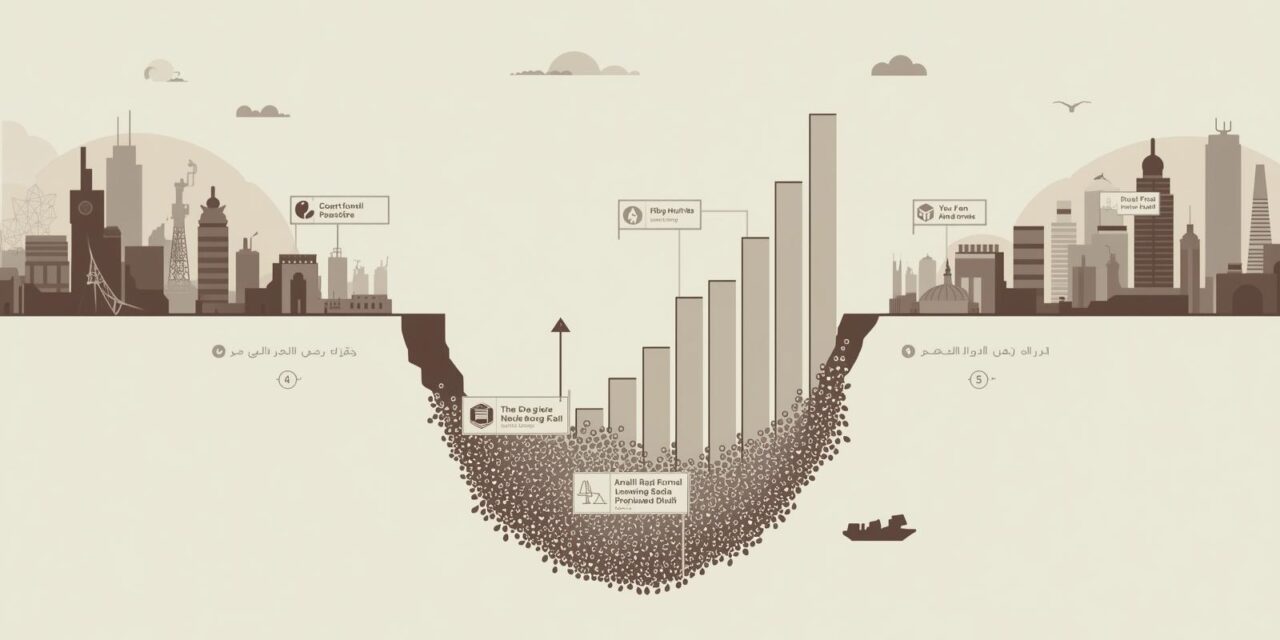
Growth Without Maturity
Oman is creating more startups than at any point in its recent economic history, yet very few of them are becoming meaningfully larger businesses.
Official data from 2025 points to a private sector that appears active and expanding. Business registrations continue to rise, and micro-enterprises now dominate the economic landscape. However, this headline growth masks a deeper structural problem. Almost all expansion is happening at the smallest end of the market, while medium-sized enterprises, the firms that typically drive productivity, exports, and stable employment, have effectively stopped growing.
This is not a problem of weak ambition or limited entrepreneurial ability. It is the outcome of a system that lowers the barriers to starting a business but sharply raises the cost and complexity of scaling one. As firms approach key thresholds in employment, revenue, and compliance, they face abrupt increases in tax exposure, labor obligations, and financing constraints.
For many business owners, remaining small is the rational economic choice. The result is a missing middle.
Oman has thousands of small firms but too few companies capable of building industrial capacity, anchoring supply chains, or competing beyond domestic markets. If Oman Vision 2040 is to deliver sustained productivity growth rather than just higher business counts, this structural imbalance requires direct attention.
The Data Beneath the Headline Numbers
Aggregate enterprise growth figures conceal a clear imbalance in firm size distribution.
According to the National Centre for Statistics and Information, total active enterprises grew by 12.1% year on year in the second quarter of 2025. Almost all of this growth came from micro-enterprises employing between one and ten people, which expanded by 14.3%. In contrast, medium-sized enterprises employing between 51 and 150 people recorded growth of just 0.1%.
This matters because firm size is closely linked to economic outcomes. Micro-enterprises play an important role in self-employment and social stability, but they rarely achieve economies of scale or invest heavily in technology. Medium-sized firms are more likely to professionalize operations, raise productivity, and integrate into export markets. They also tend to offer more stable wages and structured career paths.
An economy dominated by micro-enterprises can grow in number without growing in capability. Oman’s current data suggests exactly that pattern.
Why Firms Stop Growing: The Policy-Induced Ceiling
The stagnation of medium-sized enterprises is not accidental. It is shaped by a set of policy thresholds that make incremental growth financially unattractive.
The Tax Cliff at 25 Employees
One of the strongest disincentives to scaling is embedded in the corporate tax framework.
Small Omani-owned proprietorships and limited liability companies benefit from a concessional corporate tax rate of 3%. This rate applies only if the firm remains below strict thresholds, including registered capital under OMR 60,000, gross income under OMR 150,000, and an average workforce of no more than 25 employees.
Crossing any of these thresholds immediately shifts the firm to the standard corporate tax rate of 15%. For a business operating on thin margins, this represents a fivefold increase in tax liability overnight. The financial impact often outweighs the marginal gains from hiring additional staff or expanding output.
The predictable response is avoidance. Firms delay hiring, split operations across multiple legal entities, or limit reported revenue. The system rewards staying small rather than growing transparently.
The 50-Employee Regulatory Wall
A second major barrier appears at the point where a firm becomes classified as medium-sized.
Once a company exceeds 50 employees, it becomes subject to a more demanding set of labor law requirements under Royal Decree 53/2023. Employers must draft internal work regulations and secure formal approval from the Ministry of Labor. This process requires legal and human resources capacity that smaller firms typically do not maintain.
At the same time, Omanization enforcement becomes more prescriptive. Certain administrative and managerial roles are expected to be fully Omanized in firms above this threshold. For growing companies, this creates competition for a limited pool of experienced local professionals, pushing wage costs higher at precisely the moment the firm is trying to stabilize operations.
The transition from small to medium status therefore brings a sharp increase in fixed administrative and payroll costs.
The Wage and Social Cost Escalator
Labor costs have also become more rigid for larger employers.
Ministerial Decision No. 317/2025 introduced mandatory annual salary increments for Omani employees ranging from 2% to 5% based on performance. While this policy supports workforce welfare, it converts labor costs into a steadily rising fixed obligation. When combined with social security contributions of between 11.5% and 12.5%, the cumulative burden is significant for firms with growing headcounts.
Micro-enterprises often rely on family labor or flexible arrangements that limit exposure to these costs. Medium-sized firms, by contrast, must absorb them fully, further widening the cost gap between staying small and scaling up.
The Financing Gap: Stuck Between Grants and Banks
The missing middle is also a financing problem.
At the micro-enterprise level, access to capital has improved. In 2025, the Future Fund Oman expanded SME lending through dedicated portfolios managed by platforms such as Beehive. These instruments provide relatively fast, collateral-free financing suitable for small loan sizes.
Medium-sized firms require a different type of capital. Investments of OMR 250,000 to OMR 5 million are often needed to expand facilities, modernize equipment, or enter new markets. This is where the system becomes restrictive.
Commercial banks, despite a Central Bank target to allocate 5% of credit to SMEs, continue to rely heavily on collateral-based lending. Typical interest rates remain around 3.7%, and hard assets such as land or real estate are usually required. Many growing firms, particularly in services, logistics, or light manufacturing, do not possess sufficient fixed assets to meet these conditions.
Equity financing is also misaligned. Venture capital activity tends to focus on technology startups with high growth multiples. Traditional businesses such as food processing, transport, and industrial services rarely fit these investment mandates, leaving them without access to patient growth capital.
Strategic Risk to Oman Vision 2040
The stagnation of medium-sized enterprises poses a direct risk to national development objectives.
Micro-enterprises contribute to employment absorption, but they do not typically drive productivity growth or export expansion. Medium-sized firms are the segment most likely to invest in process improvement, adopt new technologies, and participate in regional supply chains.
By incentivizing firms to remain small, the current framework prioritizes business quantity over economic quality. Over time, this limits wage growth, industrial depth, and competitiveness. It also increases dependence on large firms and public sector activity to anchor the economy.
For Oman Vision 2040 to succeed, firm growth must become a core policy objective rather than a byproduct.
What Needs to Change: Fixing the Middle, Not the Margins
Addressing the missing middle does not require radical intervention. It requires targeted adjustments to smooth the growth path.
A graduated corporate tax structure would reduce the incentive to stall growth. Replacing the abrupt shift from 3% to 15% with incremental steps would allow firms to scale without facing immediate financial shock.
Regulatory grace periods for firms crossing the 50-employee threshold would help businesses adjust to higher compliance requirements. A defined transition window of two to three years would encourage formal growth while maintaining labor protections.
Finally, the Future Fund Oman could establish a dedicated scale-up financing window focused on traditional sectors. Lending decisions based on cash flow, contracts, and operational performance rather than fixed asset collateral would better reflect the realities of growing firms.
Conclusion: From Startup Nation to Growth Economy
Oman has made clear progress in lowering the barriers to entrepreneurship. The next challenge is to remove the barriers to maturity.
An economy dominated by micro-enterprises can appear active while remaining structurally fragile. Medium-sized firms are the link between entrepreneurial energy and long-term economic capability.
Designing policy that allows them to grow is not a market correction, it is a strategic choice.
Without changes to taxation, regulation, and financing, Oman risks producing startups that never become engines of growth. With the right adjustments, the missing middle can become one of the strongest pillars of the Vision 2040 economy.