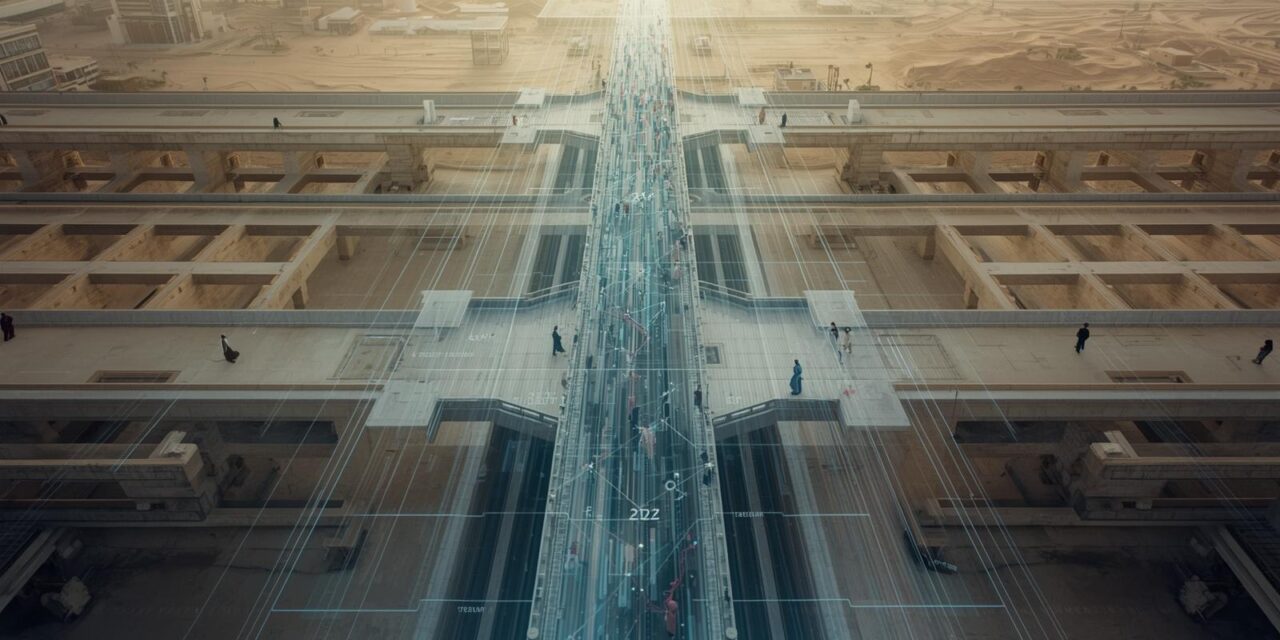
Each year, more than two million people converge on Makkah within a matter of days. They arrive from over 180 countries, move on fixed schedules, and must complete a precise sequence of rituals across a confined geographic area.
No other event on Earth combines this scale, density, and time sensitivity.
For Saudi Arabia, the Hajj is not only a spiritual responsibility but also one of the most complex logistics operations ever executed. The margin for error is narrow. Small delays can cascade into dangerous crowd density. Safety depends on predicting movement before congestion forms, not reacting after it appears.
This is where quantum computing enters the discussion, not as abstract research, but as a potential tool for managing one of the Kingdom’s most demanding real-world systems.
The Hajj as a Logistics Constraint Problem
From a systems perspective, the Hajj is defined by constraints. Pilgrims move through Mina, Arafat, Muzdalifah, and the Jamarat in a fixed order. Time windows are non-negotiable. Routes are shared by pedestrians, buses, and service vehicles. Weather conditions shift. Human behavior introduces uncertainty.
For engineers, this creates a combinatorial optimization problem. Every routing decision interacts with thousands of others. When one variable changes, such as a delayed convoy leaving Arafat, the impact can propagate hours later at the Jamarat Bridge.
Classical computing systems struggle with this type of problem at scale. They can calculate optimal paths for individual segments, but recalculating the entire network dynamically becomes computationally expensive as variables increase.
The result is delayed insight rather than predictive control.
Crowd Density and the Risk of Instability
The most sensitive phase of the Hajj occurs during Ramy al-Jamarat. At high densities, crowds no longer behave as individuals. Once density approaches six to seven people per square meter, movement becomes unstable and dangerous.
Saudi authorities have significantly reduced risk through infrastructure investment, including the multi-level Jamarat Bridge, controlled scheduling, and AI-based monitoring. These measures focus on detection and response. They work by identifying risk conditions as they form.
The remaining challenge is anticipation. Understanding how a disruption in one location will influence crowd density elsewhere hours later requires modeling millions of interacting variables simultaneously.
Why Quantum Optimization Changes the Equation
Quantum computing is relevant here because it approaches optimization differently. Algorithms such as the ‘Quantum Approximate Optimization Algorithm‘ are designed to evaluate many possible solutions in parallel and converge on high-quality outcomes quickly, even when the solution space is vast.
For problems like traffic routing and fleet allocation, this matters. Instead of recalculating routes sequentially, a quantum system can evaluate network-wide outcomes together. This makes it better suited for minimizing overall congestion rather than fixing isolated bottlenecks.
Research within Saudi Arabia has already begun testing quantum optimization against classical approaches for traffic flow and signal timing. Early results suggest potential advantages in managing system-wide congestion, particularly when conditions change rapidly.
Applied to the Hajj, this could mean recalculating bus routes for tens of thousands of vehicles simultaneously, based on projected downstream effects, not just current congestion.
From Pilots in Riyadh to Application in Makkah
Saudi Arabia is not starting from zero. Riyadh has served as a testing environment for advanced traffic management systems, generating detailed datasets on vehicle flow, incident response, and congestion patterns. These datasets are essential for training and benchmarking optimization algorithms.
NEOM adds another layer. Its logistics planning relies on predictive models that anticipate demand before it materializes. This mirrors the Hajj requirement, where authorities must predict pilgrim movement patterns hours in advance to maintain safety.
Together, these initiatives function as controlled environments where optimization techniques can be refined before deployment in the far more sensitive context of the Holy Sites.
What This Means for the Pilgrim Experience
For pilgrims, none of this technology needs to be visible. Its impact would be felt through smoother movement, reduced waiting times, and clearer guidance.
The ‘Nusuk platform’ already coordinates permits and scheduling. In a future model supported by advanced optimization, it could dynamically adjust movement windows based on projected safety conditions. A pilgrim might receive a message advising a short delay or reroute, not because congestion has occurred, but because the system predicts it will.
The ritual remains unchanged. The difference is that the complexity of coordination is handled by computation rather than manual intervention.
A Strategic Model Beyond the Hajj
The significance of this approach extends beyond a single event. If Saudi Arabia can manage the most complex annual human gathering on Earth using predictive optimization, the same principles apply to urban mobility, emergency response, and large-scale infrastructure coordination.
The Hajj becomes a proving ground. Not for experimentation on pilgrims, but for demonstrating how advanced computation can support human safety at extreme scale.
The promise of a quantum-enabled Hajj is not technological spectacle. It is precision, foresight, and restraint, using advanced mathematics to protect a sacred obligation while allowing pilgrims to focus entirely on its spiritual meaning.